

What Each Stage of Change Actually Asks of a Coach
Picture a coaching session in its third month. The client came to you with a goal she had named clearly: getting consistent sleep. By now she has bought the tracker, deleted the late-night social apps, walked through her stress patterns with you, and identified the cup of green tea she keeps drinking at nine in the evening. She knows, on paper, what to do. She still goes to bed at half past midnight, four nights out of five. This week she sat down across from you, exhaled, and said, “I do not know why I cannot just do it.”
In that moment a coach has a choice. The reflex, which feels professional and supportive, is to lean harder on the plan. Refine the bedtime routine. Add a twenty-minute wind-down. Build accountability with a check-in text. The other option, the one that requires more skill and more restraint, is to step back and ask a different question entirely. What stage of change is this client in this week, and is the work I am offering matched to it? Most coaches reach for the plan. The Stages of Change model, taught well and used week to week, is the discipline of not doing that.

The Stages of Change model, also called the Transtheoretical Model, was developed by James Prochaska and Carlo DiClemente in the late 1970s, originally to describe how smokers either stopped smoking on their own or continued. What the research has revealed, replicated across dozens of behaviors since, is that change is not an event. It is a sequence of internal shifts that move through five recognizable stages. People can move forward through them, slip backward, cycle, and re-enter at any point. Most coaches have heard the names: Precontemplation, Contemplation, Preparation, Action, Maintenance. Far fewer use the model as an actual working frame across sessions. The result is a common pattern in coaching practice. The coach is doing Action-stage work. The client is in Contemplation. Both are sincere, both are working hard, and the sessions still feel like they are not quite landing.
What follows is a stage-by-stage playbook for what each stage actually asks of a coach, and what a coaching session in that stage tends to look like when the work is matched to the client’s location.
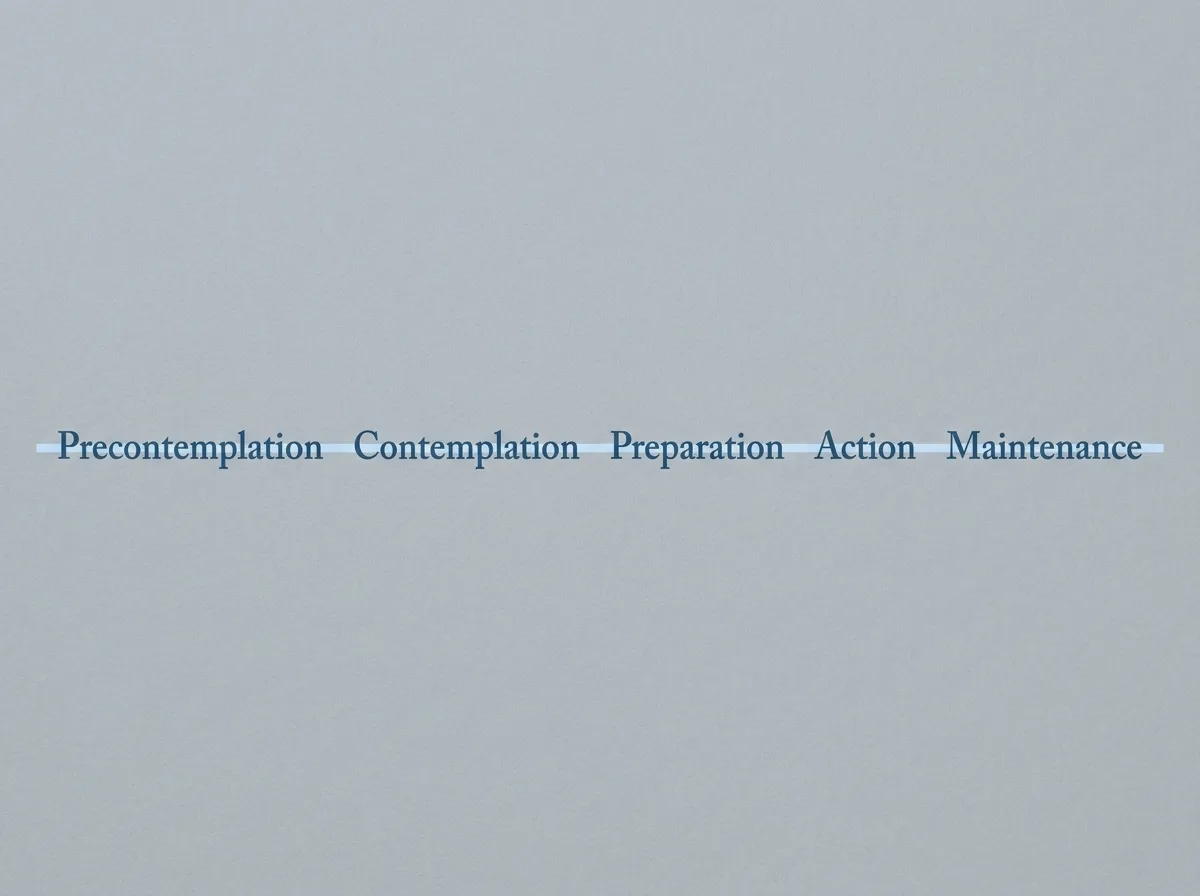
Precontemplation: Stay in the Room Without Pushing for Change
Precontemplation is the stage in which the client is not seriously considering change in the foreseeable future, often defined in the literature as the next six months. They may have come to coaching because a partner suggested it, because a doctor flagged a number, because work is paying for it, because they thought they should. They are not yet convinced that the change in question is necessary, possible, or desirable for them.
The reflex move at this stage is to recruit motivation. To explain the stakes. To describe what is at risk. To problem-solve. None of it works. What the research on this model consistently shows is that pushing harder in Precontemplation produces resistance, not motion. The coach’s job at this stage is not to drive change. It is to stay in the room without abandoning the client and without faking enthusiasm for a goal that is not yet theirs.
The work of Precontemplation looks small from the outside. Genuine curiosity about the client’s actual life. Reflection on what the client has already told you. Light, non-pressuring questions that invite the client to articulate their own ambivalence rather than defend against yours. The coaching skill at this stage is restraint paired with presence. The session that ends well in Precontemplation is the session in which the client felt fully heard and was not asked to commit to anything.
Contemplation: Hold Both Sides Without Resolving Them
Contemplation is the stage in which the client is seriously considering change, often within the next six months, and is also actively weighing its costs. Most coaches encounter their clients here more than anywhere else. The client wants the change. The client also notices what they would lose. The two views are simultaneous, and the client is moving between them session to session. One week they sound ready. The next week they sound like they have walked it back.
The reflex is to grab the ready week and run. To turn the readiness into a plan, set the goals, and start the action work. The client agrees in the room. Then the next week’s check-in comes back flat, the goals untouched, and the coach feels the familiar deflation. Acting on a momentary readiness in a Contemplation client is one of the most common reasons coaching engagements stall.

What Contemplation asks of a coach is the capacity to hold both sides at once. Not to resolve the ambivalence prematurely, but to make it speakable. The questions that work here are versions of what would be different if you did, and what would you miss. The coach’s job is to widen the client’s awareness of both directions until the client can move toward change with their full self, not just the part of themselves that is performing for the coach. Motivational interviewing research is the cleanest body of work on what skillful Contemplation-stage coaching actually involves.

Preparation: Shrink the Goal Until It Is Small Enough to Start
Preparation is the stage in which the client has decided they are going to make the change, usually within the next month, and is gathering the resources to do so. The energy is different. The client is buying the running shoes, looking up the app, putting the gym session on the calendar, making the first appointment. The internal work of deciding has happened. The external work of arranging is underway.
The reflex at this stage is to support an ambitious plan. The client is excited, the coach is excited, and the work feels productive in a way Contemplation never did. The plan that comes out of those sessions, almost without exception, is too big.
What Preparation asks of a coach is the discipline of shrinking the goal until it is small enough to actually start.
Most clients in Preparation overestimate what they can sustain in week one. The coach’s task is to help them choose a first action that is so small it almost feels embarrassing, knowing that the embarrassment is the indicator the goal is correctly sized. Two minutes of meditation, not twenty. Walking to the end of the driveway, not running a mile. Drinking one glass of water before coffee, not tracking macros. Preparation work is the bridge between intention and behavior, and bridges hold weight only when their first span is short enough to cross.
Action: Track Behavior, Not Feelings
Action is the stage most people picture when they think about change. The client is doing the new behavior. They have started the workouts, the food log, the new sleep window, the daily walk. The behavior is happening, often imperfectly, and the client is feeling the friction of doing something new in a life that was organized around something else.
The reflex in Action is to ask the client how they feel about the change. The question is well-meant. It is usually a mistake. Feelings in Action are unreliable narrators. Clients can do the new behavior consistently and feel terrible about it. They can fall off entirely and feel fine. What predicts whether the change holds is not the emotional texture of week three. It is the behavioral consistency.
What Action asks of a coach is the discipline of tracking behavior rather than feelings, while still validating the human experience of doing something hard.

The coaching session in Action looks like a clear-eyed accounting of what the client did and did not do, paired with curiosity about what made the doing possible or hard. It is not interrogation. It is not punishment. It is steady, honest, behavior-anchored conversation. The client who feels supported in Action is the client whose coach treats their behavior, not their feelings about their behavior, as the operative data.
Action is also where boundary clarity matters. When a client’s struggle to act surfaces something deeper, like persistent depressive symptoms, an unresolved trauma response, or a medical concern, the coaching role names it and refers. The coaching role has a defined scope, and Action-stage clarity about that scope is part of what protects the coaching relationship and the client.

Maintenance: Build the New Normal
Maintenance is the stage in which the client has been doing the new behavior for at least six months and is learning to live with it as part of their life rather than as a project. The novelty has worn off. The routine is in place. The client is no longer thinking about the change every day. They are just living differently.
The reflex at this stage is to celebrate and dial down the coaching engagement. The work is done, the change has held, and the client does not seem to need the same intensity. That instinct is partly correct. The energy of Maintenance is genuinely calmer than the energy of Action. What it misses is what Maintenance actually requires.
Maintenance is not the absence of work. It is the long work of integration. The risk in Maintenance is not collapse, though collapse can happen. The deeper risk is drift. Old environmental cues reassert themselves.
Stressful seasons rearrange priorities. Travel, illness, relationship change, and work transitions all create moments where the new behavior could quietly stop being the default. The Maintenance-stage coach’s job is to help the client notice those moments early, to maintain rituals that keep the behavior visible, and to support the client’s emerging identity as someone for whom this is now just what they do.
The good news of Maintenance, and the part most clients do not see at the start, is that the behavior eventually stops requiring effort. It is no longer a goal. It is a feature of the life. A coach who has walked a client from Precontemplation through Maintenance has been part of a real change in someone’s life, and that is a different thing than running a series of well-organized sessions.
Across all five stages, what the model actually asks of a coach is the willingness to meet the client where they are rather than where the coach would prefer them to be. Most stalled coaching engagements are misaligned, not unmotivated. The client is in one place and the coach is doing the work of another place. The Stages of Change model, used as a working frame across sessions and not just a familiar name, gives coaches a vocabulary for the misalignment and a sequence for catching it before it becomes a stuck pattern. The model also gives coaches the permission they sometimes need to slow down. Many of the moments that feel like coaching is failing are moments of correct, stage-matched work that the coach has been trained to think of as not enough. Precontemplation done well looks like a quiet conversation. Contemplation done well looks like ambivalence held openly. Both are real coaching, and both are part of the change.
This kind of stage-aware coaching, the patience to hold a Contemplation client in their ambivalence, the discipline to shrink a Preparation goal until it actually starts, the willingness to track behavior in Action without flinching, is the work of a board-certified health coach. AANWC supports coaches doing this kind of working craft through a community of peers, an advisory board representing more than 240 years of combined health and life coaching experience, and over 35 board certification titles that name what coaches actually do.