You Know You Are a Strong Coach — Here Is
How to Prove It Publicly
You already know the level at which you are operating.
Your sessions have a deliberate shape. Your communication is purposeful. You understand how behavior changes, how clients get stuck and unstuck, and how the difference between a surface-level interaction and real transformation actually feels in practice. Clients return. They refer their closest friends. They trust you not because you told them to, but because the work has demonstrated it over and over.
From the inside, there is no question about where you stand.
From the outside, there is nothing publicly verifiable that reflects it.
That tension is one of the most common professional experiences among health coaches who have moved past the early stages of their practice. The work is strong. The client outcomes are consistent. The depth is real. But there is no external standard that distinguishes you from someone who completed a weekend course and printed a certificate.

That absence is not a gap in your ability. It is a gap in how the field currently represents ability to the outside world. Exam-based board certification through ANWCB was built for exactly that moment.
The Difference Between Knowing and Being Verified
Consider a coach named Dana. She has been running her own health coaching practice for six years. Her background includes a formal program in health coaching and ongoing continuing education in behavior change methodology. Her client roster is full. Word-of-mouth referrals come in consistently. She has built the kind of reputation that takes years of careful, skilled work to earn. When a prospective client recently asked her what credentials she held, Dana sent over her program certificate and a link to her website. The client thanked her and went with someone else, someone who appeared in a publicly searchable professional registry. Dana’s work was not the problem. The absence of any publicly verifiable record of her competency was.
Dana’s situation is not unusual. It reflects a gap that many experienced coaches running their own independent practices encounter as their reputation grows and the stakes of each new client decision increases. The problem is not competency. The problem is that nothing external verifies it.
That is the distinction exam-based board certification is designed to close. It does not evaluate whether you have trained. It evaluates whether you can demonstrate what you know under formal examination and places that demonstration in a record that others can independently confirm.

Two Standards, Two Different Questions
Health coaching credentialing currently operates along two distinct lines, and understanding the difference between them is essential to making an informed decision about which path fits your professional goals.
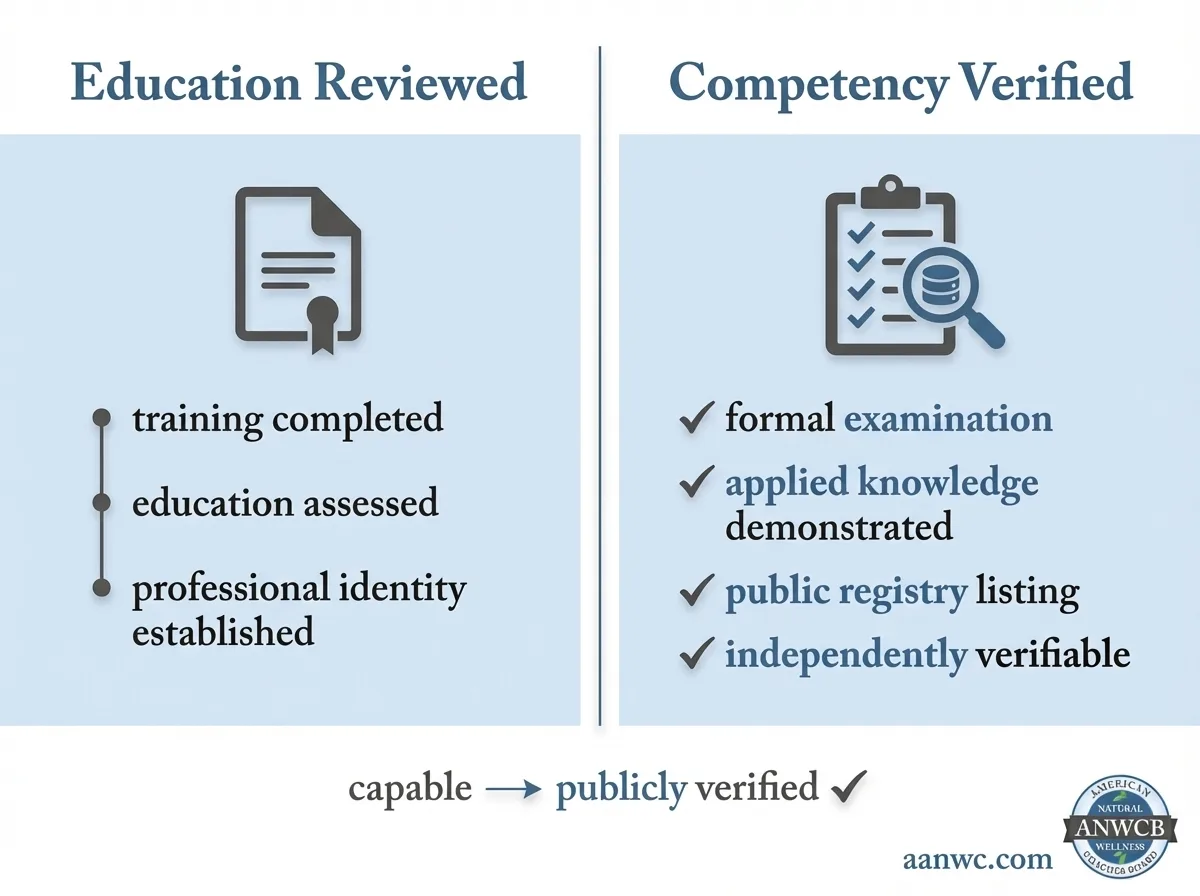
Education review is the model most coaches encounter first. A program is completed, training is assessed, and a professional identity is established based on that review. AANWC board certification operates within this model. It reviews a coach’s education against a defined standard, confirms that the training meets recognized criteria, and creates a professional identity grounded in real preparation. This is meaningful work. It is what separates coaches who have invested seriously in their formation from those who have not.
But education review answers one question: was this coach educated?
Exam-based board certification requires the coach to sit for formal examination and demonstrate applied knowledge in the areas that define professional health coaching practice. These include behavior change methodology, client communication frameworks, ethical practice, and the applied coaching principles that differentiate skilled practitioners from those still developing. The examination creates a record. That record is then placed in the International Registry, where it becomes publicly visible and independently verifiable.
One model validates education. The other verifies competency. Both are legitimate. They are not competing answers to the same question. They are answers to different questions, and for coaches who are ready to be tested, the exam-based path provides a public signal.
Why Verification Matters in a Crowded Field
Health coaching is one of the most accessible professional spaces in the wellness field. That accessibility has created genuine opportunity, but it has also created a challenge that experienced coaches feel directly. Anyone can claim the title. Without a defined external standard, there is no consistent way for clients, referring practitioners, employers, or organizations to distinguish between a coach with deep training and tested competency and someone with minimal preparation.
This is not a theoretical problem. It is the operational reality that coaches with strong practices encounter when they attempt to formalize referral relationships, join provider networks, or represent themselves to institutions that require documented professional standing.
Exam-based board certification creates a visible, verifiable line. Not based on marketing language or self-description but based on the fact that the coach has been tested against a defined standard and the result is documented in a publicly searchable registry. Clients can look it up. Referring practitioners can confirm it. Organizations that require demonstrated competency can verify it without relying on the coach to explain it.
That is what verification actually does. It removes the burden of explanation and replaces it with documentation that speaks for itself.
The International Registry and What Public Listing Means
Verification is only meaningful if it is visible. The ANWCB International Registry addresses this directly. Coaches who achieve exam-based board certification are publicly listed in a searchable record that operates independently of the coach’s own documentation or self-reporting.
This matters because it shifts the nature of the credential. A certificate held in a folder answers questions only when it is presented. A listing in a public registry answers questions whenever someone decides to look. Clients who want to confirm professional standing can do so on their own. Organizations that require demonstrated competency as part of a referral or partnership process can verify it without putting the burden of documentation entirely on the coach.
You can view how registry listing functions by reviewing the ANWCB board certification registry. The listing is not a private record. It is a public one, and that distinction changes the professional signal your credential carries.
Practical Support Beyond the Examination
ANWCB exam-based board certification extends well beyond the examination itself. The certification includes public registry listing in the International Registry, which functions as the primary differentiating element for coaches who want their standing independently verifiable. It also includes pre-qualification for professional liability insurance through Lockton Affinity, a practical consideration for coaches who operate at a level where coverage reflects how seriously they take their practice. For coaches based in the United States, ANWCB certification also provides pre-qualification for a GEHA ecclesiastical license (U.S.-only), an additional layer of safety and legality.
Beyond those individual qualifications, certified members gain access to an extensive library of member-only benefits including practitioner discounts, referral networks, and coupon codes for products and services.

The free application process is completed entirely online, removing logistical barriers for coaches who are managing a full client load while pursuing certification. Certified coaches also receive the “Board Certified by” emblem for use in their marketing materials, providing a visible, professional credential mark across their website, social profiles, and client communications. The exam standard itself is governed by an Academic Advisory Committee composed of wellness professionals, which ensures that what is being evaluated reflects real-world coaching knowledge rather than theoretical frameworks removed from practice.
Taken together, these elements create a credential model that serves a specific professional purpose. It is not designed for coaches who are still building foundational skills. It is designed for coaches who are ready to operate at a higher level of professional visibility, who want their standing documented, their marketing backed by a recognized emblem, and their practice supported by a network of practical resources. One additional point worth noting: ANWCB considers all qualifying education when evaluating applicants. Completion of an AANWC or ANWCB accredited school program is not a prerequisite. Coaches who trained through programs outside that accreditation framework are eligible, and their education will be reviewed on its own merits.
For a complete overview of both options, visit: https://aanwc.com/aanwc-anwcb-board-certification/.
Choosing the Path That Matches Your Professional Stage
AANWC and ANWCB serve the same professional lane with different instruments. That is a distinction worth holding clearly.
AANWC board certification is the right foundation for coaches whose education meets a defined standard and who want that education recognized within a professional body. It creates a recognized professional identity grounded in real training, establishes belonging in a credentialing framework, and provides a clear professional community. For coaches who have completed serious training and want that training formally acknowledged, AANWC provides precisely that.
ANWCB exam-based board certification is the next layer for coaches who are ready to be tested. Some coaches choose to hold AANWC board certification and later pursue the exam-based path as an additional layer of verification. Others move directly into exam-based certification because they are confident in their knowledge and want to demonstrate it under formal evaluation. Neither sequence is superior. They reflect different professional goals and different moments in a coaching career.
What matters is that both paths exist within the same professional lane, that they are clearly differentiated, and that each serves a real function. Coaches in the health coach lane who are considering either path should understand that the decision is not about choosing the more legitimate option. It is about choosing the path that matches where they are and where they want their professional identity to stand.

The Moment When Being Capable Is No Longer Enough
At a certain point in a coaching career, the internal question is settled. You know what you are capable of. You have seen it work, repeatedly, with real people in real situations. The question is no longer about ability.
The question is about documentation.
Without a mechanism for public verification, strong coaches carry the ongoing burden of explaining their expertise every time it is questioned. The explanation may be accurate. It may even be persuasive. But it is still an explanation, offered by the person whose standing is at issue, about their own level of competency. That is a fundamentally different signal than a public record that states, independently and verifiably, that this coach was evaluated and passed a defined standard.
Exam-based board certification through ANWCB exists for the coach who is done explaining. It is for the coach who has reached the level where the next move is not more training or more experience. It is documentation that places what they already know into a record that others can see, confirm, and rely on without any further interpretation required.
That is the shift. Your education reviewed, your knowledge tested, your competency publicly verified. From capable to verified. From self-described to publicly documented. From strong to provably strong.