

Why a Ten-Minute Walk After Eating Changes the Glucose Picture: The Muscle Mechanism
A coach meets a client three weeks into her new approach. She has cut back on bread and pasta, swapped sugary drinks for sparkling water, and added a vegetable to every dinner. She brings in her continuous glucose monitor data, which she purchased on her own, and she is frustrated. The morning fasting numbers look better. The post-meal numbers are still climbing into ranges she does not want to see, especially after lunch. She has done what every popular article told her to do, and the curve she sees on the app is not the curve she expected.
The coach has a choice in this moment. She can offer another food adjustment, which the client has been chasing for weeks already and which has begun to feel like deprivation without payoff. Or she can introduce a small movement habit that, on its own, often does more for the post-meal glucose curve than the most disciplined plate. A ten-minute walk after eating sits in this second category. It is small enough to feel doable. It is grounded in a metabolic mechanism the coach can explain in plain language. And the research base is unusually strong for an intervention this simple.

What Happens to Glucose After a Meal
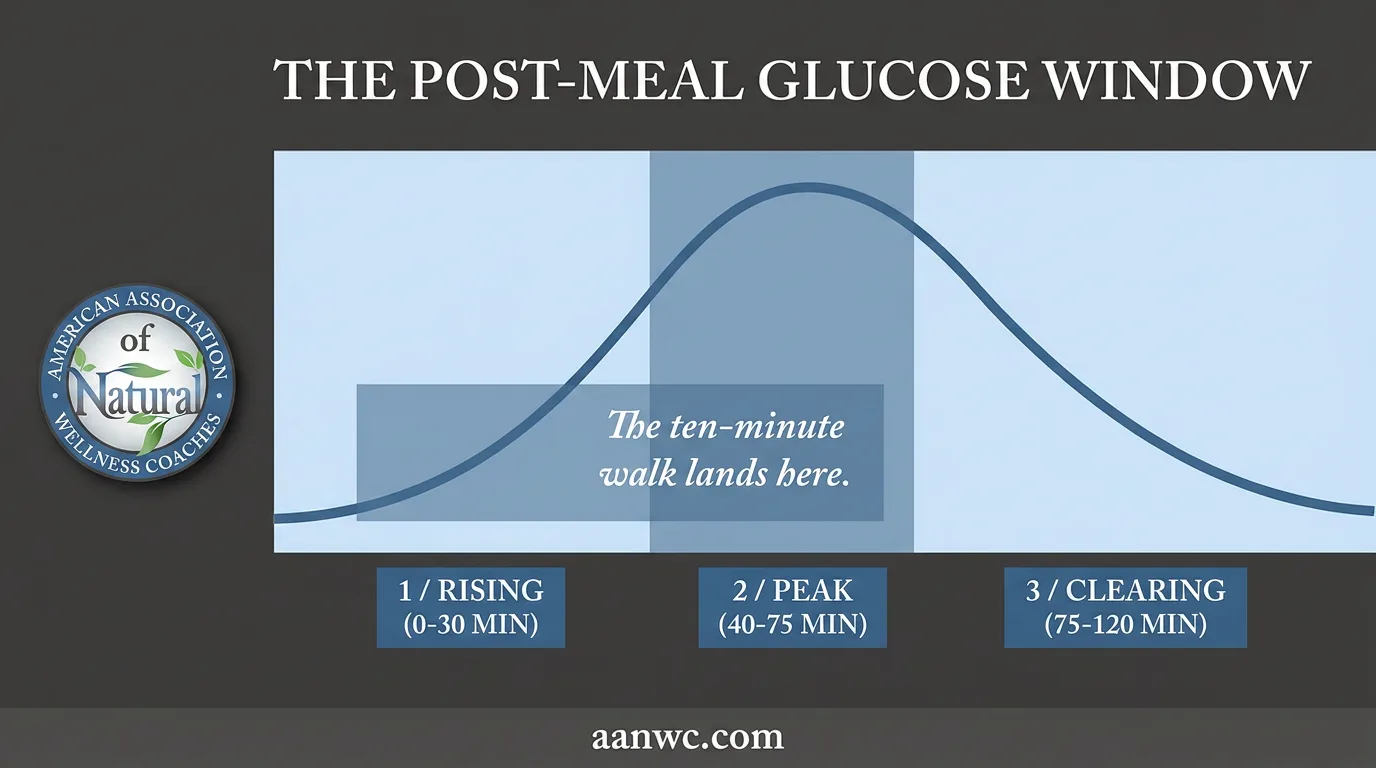
When a meal containing carbohydrate is digested, glucose enters the bloodstream over the next ninety minutes or so, with the peak typically arriving forty to seventy-five minutes after the first bite. The pancreas releases insulin in response, and insulin acts as a key that allows glucose to leave the bloodstream and enter cells where it is either used for energy or stored. The glucose curve a client sees on a monitor is the visible result of this two-sided dance: how much glucose is entering the blood, and how quickly it is being pulled out.
For some clients, the curve is mild and brief. The glucose rises by thirty to fifty milligrams per deciliter, peaks softly, and returns to baseline within two hours. For others, the curve is steeper and longer. The peak is higher, the descent is slower, and the next meal often arrives before the previous spike has cleared. Over years, the second pattern is associated with the development of insulin resistance, weight gain in the abdominal region, and the slow rise in fasting glucose that marks the early years of prediabetes.
The two main inputs a client can change are what enters the bloodstream, which is largely about the meal itself, and what pulls glucose out of the bloodstream, which is where movement enters the picture. A client who has already adjusted her meals is now standing at the second lever. She is asking, often without knowing she is asking, how to help her body clear glucose more efficiently.
The Muscle as a Glucose Reservoir
Skeletal muscle is the largest single destination for glucose in the body. After a meal, roughly seventy to eighty percent of the glucose that leaves the bloodstream is taken up by muscle tissue. The remainder goes to the liver, the brain, fat tissue, and other organs in smaller fractions. This single fact is the reason post-meal movement has the effect it does: the largest glucose sink in the body responds quickly to being asked to work.
Inside muscle cells, glucose enters through a transporter called GLUT4. When the cell is at rest, most GLUT4 transporters sit inside the cell on small membrane vesicles, not on the surface where they would actually move glucose. To work, they have to be brought to the cell surface, a process called translocation. There are two main signals that cause this. The first is insulin. The second, importantly, is muscle contraction itself.
The contraction signal works through a different molecular pathway than the insulin signal, which has a practical consequence the coach can use. When a client walks after a meal, her muscles do not have to wait for insulin to do all the work. The walking itself recruits GLUT4 to the surface of working muscle cells, and glucose moves out of the bloodstream and into the muscle whether or not the insulin signal is operating at full strength.
For a client whose insulin signaling is sluggish, which describes most of the people who present with frustrating post-meal numbers, this is the mechanism that bypasses the bottleneck.
The contraction-mediated pathway has been studied for decades, with the foundational work showing that exercise can move glucose into muscle even in tissue where insulin signaling is severely impaired. Reviews of this literature consistently identify it as one of the most reliable findings in metabolic physiology.
Why Light Movement Outperforms Sitting Through It
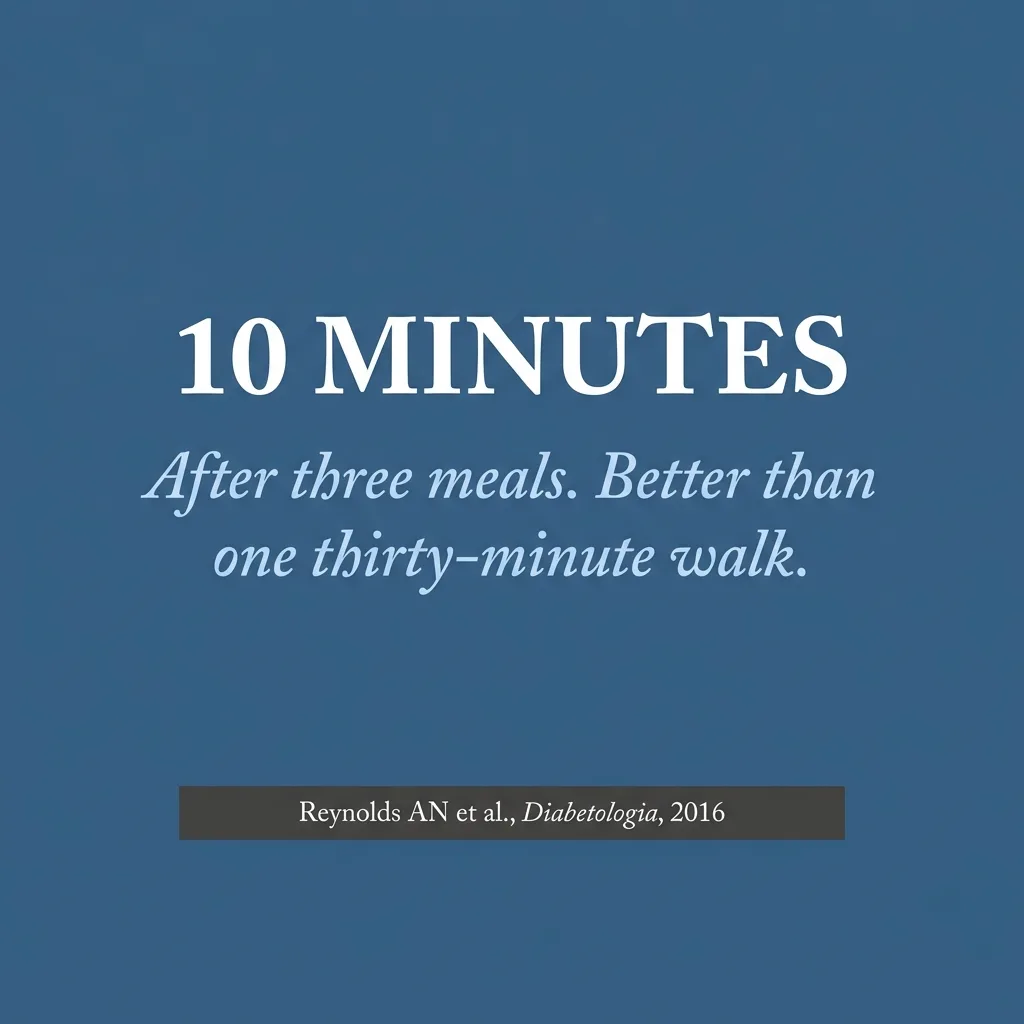
A common assumption is that the walk has to be brisk to matter. The research says otherwise. In a frequently cited 2016 trial published in Diabetologia, participants with type 2 diabetes who walked for ten minutes after each main meal showed lower twenty-four-hour glucose averages than the same participants when they did one longer thirty-minute walk earlier in the day. The total movement time was identical. What changed was the timing.
An earlier study from DiPietro and colleagues showed similar timing effects in older adults at risk for glucose intolerance. Three short post-meal walks distributed across the day produced better twenty-four-hour glucose patterns than a single longer session of equivalent duration. The mechanism is the one already discussed: catching the glucose curve while it is rising, when the muscle can do its largest share of work pulling glucose out of circulation.
The dose that consistently shows an effect is in the range of ten to fifteen minutes of light to moderate walking, beginning within fifteen to thirty minutes of finishing a meal. The pace does not have to feel like exercise. A casual conversational pace, the speed at which someone can comfortably talk on the phone, is enough. Speed adds modestly to the effect, but the threshold finding is that movement at any walking pace, started while the glucose curve is rising, has a meaningful effect on where the curve peaks and how quickly it descends.
This is unusually useful information for a working health coach. The intervention is short. The pace is gentle. The timing window is flexible. Most clients can fit a ten-minute walk after lunch into a workday without changing anything else about how they live.
Translating the Mechanism for a Client
The mechanism the coach has just learned does not need to be delivered to a client as a biology lecture. Most clients have already had the experience of being talked at about their bodies, and that experience often closes the conversation down rather than opening it. What the coach is looking for is the smallest amount of mechanism that will earn the client willingness to try the habit for two weeks.
A workable version might sound like this. Your muscles act like a sponge for glucose after a meal. When you sit still, the sponge is dry and the glucose has nowhere fast to go. When you walk, the sponge gets squeezed, and it pulls glucose out of your blood while it is still rising. Even ten minutes of walking right after lunch can flatten the curve we have been seeing. The biology is honest, the imagery lands quickly, and the client now has a reason to try rather than a rule to follow.
A few client objections come up reliably and deserve a coach prepared response. I do not have time usually softens once the client realizes the walk can be the route from the kitchen to the next thing she was already going to do. I do not see how a walk that short could matter is best met with a brief reference to the timing research, not by leaning on the coach as an expert. I tried this once and the numbers did not change is best met with a question about which meal she walked after, since the lunch effect is typically more visible than the breakfast effect, and a question about how long she gave the habit, since most studies measure the effect after at least two weeks of consistent practice.
The coach is not prescribing. The coach is teaching the client to read her own body pattern, and to test a small intervention with a clear feedback loop. If the client has a glucose monitor, the feedback loop is immediate. If she does not, the feedback she can track is how she feels in the two hours after lunch, how hungry she is at dinner, and whether the post-lunch slump she has been describing softens or disappears.
A few practical variants are worth having ready when life makes the textbook version impossible. When a client cannot walk after every meal, lunch is almost always the highest-leverage choice.
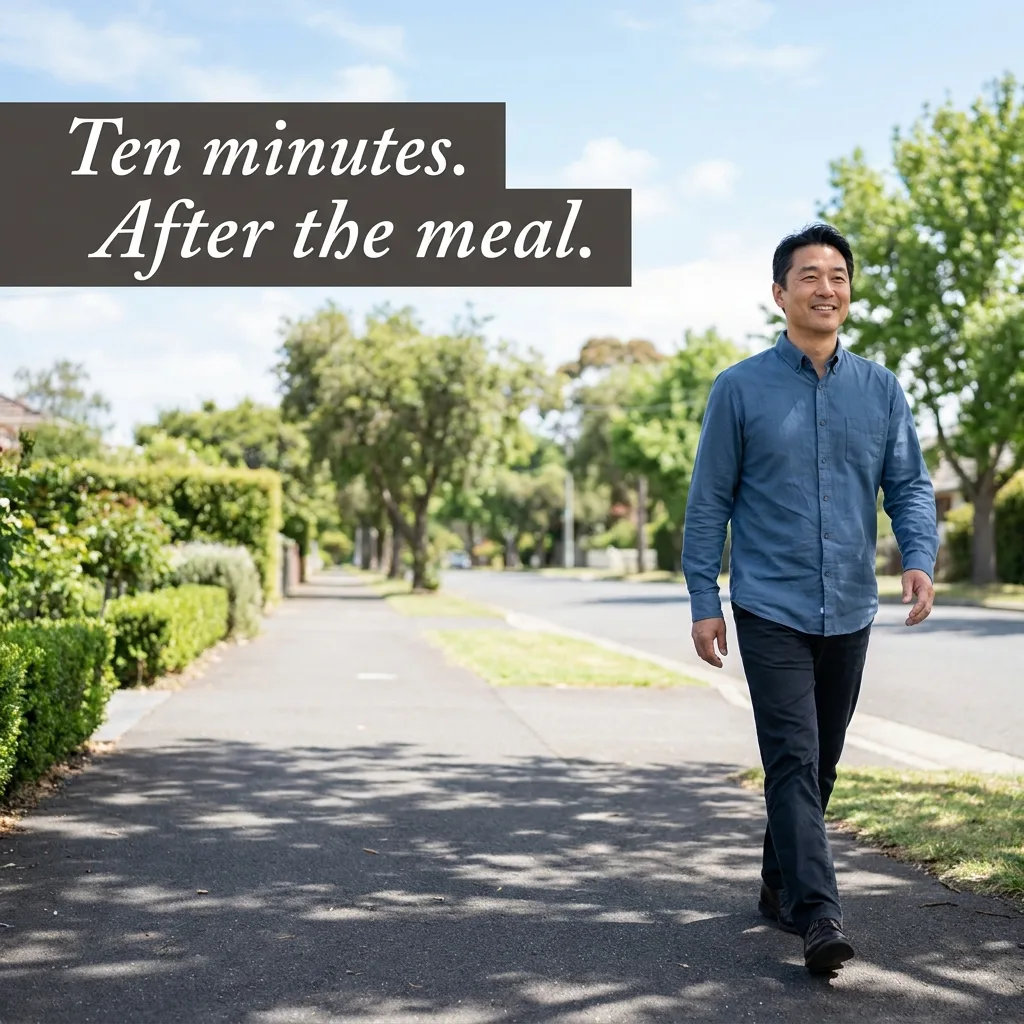
The lunch curve tends to be the steepest because it follows the largest carbohydrate load in many people’s days, and the working hours after lunch are also when most clients describe their most uncomfortable energy and concentration drops. A walk after lunch alone, on the days it is realistic, often produces enough visible change for the client to want to add the breakfast or dinner walk on her own. When walking outside is not possible, ten minutes of light indoor movement carries most of the same effect. Climbing one flight of stairs slowly, pacing in a hallway, or doing a gentle marching pattern in the kitchen all recruit the same muscle pathway the outdoor walk does. The point the coach wants to convey is that the muscle is doing the work; the location is incidental.
The coach can also help a client troubleshoot when the early results feel uneven. Not every meal will respond identically, and a single high reading after a walk does not mean the walk failed. The pattern that matters is the two-week average, not any single measurement. A meal high in refined carbohydrate, eaten when the client is also sleep-deprived or stressed, may still produce a sharp curve even with the walk. The walk has flattened that curve relative to what it would have been without the walk, but the comparison the client wants to see, set alongside her own quieter days, is not visible without a baseline. The coach can suggest tracking one or two reference meals that the client eats often, so that the same meal can be compared with and without the walk over the same two weeks.

A Note on Who This Habit Serves Best
The post-meal walk is most useful for clients whose primary concern sits inside ordinary metabolic territory: glucose curves that are higher than they want, mild insulin resistance, gradual weight gain in the midsection, post-lunch energy drops. For these clients, the intervention is low-cost, low-risk, and grounded in a mechanism that has been replicated across populations and study designs.
For clients with diagnosed type 2 diabetes, type 1 diabetes, or any condition affecting blood sugar regulation, the coach is working in partnership with that client medical team and not in front of it. The walk can be a useful supplement, but any changes to medication, insulin dosing, or treatment plan belong with the prescribing clinician. The coaching role here is the same one it always is: helping the client integrate a behavior the client and her clinician have agreed makes sense.
This kind of plain-language teaching, taking a metabolic mechanism the client has never heard of and turning it into a workable two-week habit, is the everyday work of a board-certified health coach. ANWCB supports board-certified coaches earning exam-based credentialing who do this kind of mechanism-grounded teaching with clients, coaches whose education has been reviewed, whose knowledge has been tested, and whose competency is publicly verified.