

The Signals That Tell You a Client Is Ready to Change
The plan was good. You built it together in the second session, and you remember the energy in the room while you built it. Your client named the goal without hesitation, agreed to the first two steps, and said the words every coach likes to hear: this feels doable. Three weeks later the plan has not moved. Nothing dramatic went wrong. There was a work deadline, then a sick child, then a week that simply got away, and now an apology arrives in a message sent close to midnight.
The temptation in that moment is to rebuild. Make the steps smaller, tighten the check-in rhythm, add a tracking sheet. Sometimes that works. Often it produces a second plan that stalls in the same place as the first, because the plan was never the problem. Your client was not ready to do that particular thing at that particular time, and the readiness was legible in the second session for anyone reading for it. Readiness leaves signals. They appear in what a client says, in where the energy sits during a conversation, and in what happens in the days between sessions. Learning to read all three is the difference between building for the client in front of you and building for the client you hoped for.


Readiness Is a Reading, Not a Verdict
Readiness is a state, not a trait. The transtheoretical model, which most coaches meet as the stages of change, describes behavior change as movement through precontemplation, contemplation, preparation, action, and maintenance rather than as a switch that flips. What matters for daily coaching work is the corollary: a person occupies a stage with respect to one specific behavior, not with respect to their whole life. The same client can be deep in preparation about morning movement and barely in contemplation about evening eating, in the same hour, in the same conversation.
That corollary changes what you listen for. A global question, whether this client is motivated, produces a global answer that helps nobody. A specific question, how ready this client is for this behavior this month, produces something you can build on. Readiness is also not a permanent property of a person. It moves week to week with sleep, workload, family weather, and whether the last small thing they tried actually worked.
The reason to read readiness carefully is not to sort clients into ready and not ready. That sorting is a dead end, and it puts you in the position of grading someone who came to you for support. Readiness is directional information. It tells you how large the next step can be, which part of a client’s life has room in it right now, and whether the conversation you are having is the conversation the client is actually ready to have.
The First Signal: How the Client Talks
The language people use about change has been studied more closely than most coaches realize. In a well-known analysis of recorded change conversations, researchers coded client statements for desire, ability, reasons, need, and commitment, and found that the strength of commitment language predicted behavior at follow-up. Statements of desire and ability mattered, but they mattered largely through their effect on commitment. Later work found the same pattern and added something useful: what the client said during the conversation predicted outcomes beyond whatever motivation the client walked in with.
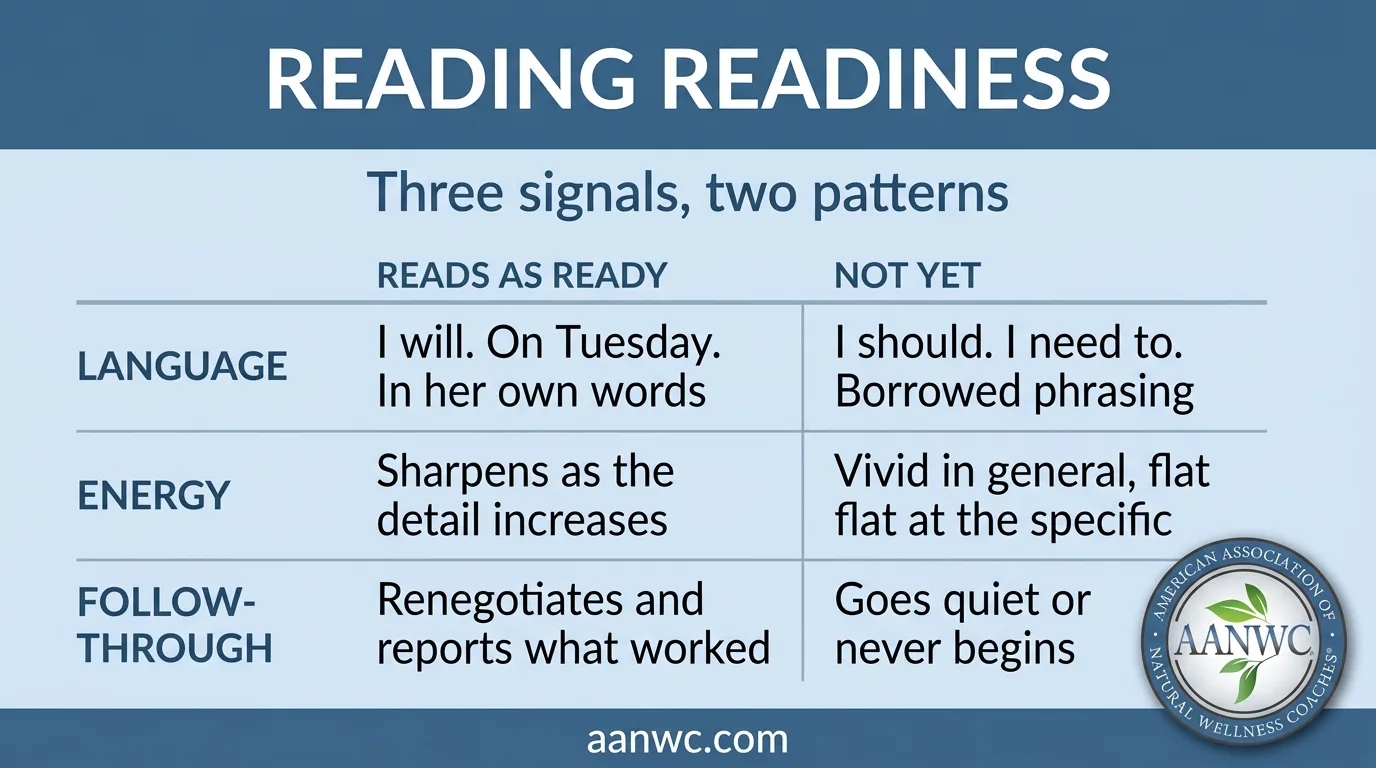
The practical translation is a distinction worth holding onto. Desire, ability, reasons, and need are preparatory language. They describe a client circling something. Commitment language is mobilizing. It has a different grammar. Preparatory language sounds like I should, I need to, I would really like to, it would be good if. Mobilizing language sounds like I will, I am going to, on Tuesday I am. The two feel similar in a warm session, and it is easy to walk away from an hour of preparatory language believing you heard a commitment.
Three things are worth listening for specifically. First, verb form. Conditional and obligation verbs point one direction, declarative future verbs point another. Second, ownership of the words. When a client describes the goal, notice whose vocabulary it arrives in. Goals borrowed from a spouse, a parent, or a recent appointment tend to keep the borrowed phrasing, and borrowed phrasing rarely survives a hard week. Third, whether the client volunteers the next step or waits to receive one. A client who says, so I think the thing to try first is, has already done work you did not have to prompt.
One more finding belongs here, and it is the uncomfortable one. Coach language shapes client language. The same research tradition found that conversation moves consistent with the method were reliably followed by client change talk, and moves inconsistent with it were reliably followed by the opposite. Some portion of what you hear from a client is a response to what you just said. That is worth sitting with before concluding a client lacks readiness, because a stretch of persuading, correcting, or fixing on your side will produce exactly the flat, hedged language you are about to read as low readiness.
The Second Signal: Where the Energy Sits
Energy is the signal coaches most often misread, because the obvious version of it is not the useful version. Warmth in a session is pleasant and tells you very little. Plenty of clients are agreeable, engaged, and delightful to talk with while remaining nowhere near acting on anything. Social energy is about the relationship. What you want to read is where the energy goes when the conversation changes altitude.
The test is specificity. Move the conversation from the general to the particular and watch what happens to the client’s animation. Someone ready gets sharper as the detail increases. Ask what time the walk would happen, who else is in the house at that hour, what happens if it rains, and a ready client leans in and starts solving. Someone not yet ready shows the reverse pattern. They are vivid and expansive while the subject is the wanting, and they go smooth and polite the moment the subject becomes Tuesday at six.
That flattening is not resistance and it is not a character problem. It is information about where the change currently lives for that person. The wanting is real. The specific has not been imagined yet, which means anything you build on the specific today will rest on nothing.

The pattern also runs the other way, which is why energy deserves its own reading rather than being folded into language. Some clients are quiet, undramatic, and easy to underestimate. They do not narrate their motivation and they do not make the room feel good. Then you mention one narrow thing, the afternoon slump or the twenty minutes after the children are down, and the register changes. The answers get more concrete. They start supplying detail you did not ask for. That is where readiness is living, and it is often nowhere near the goal named at the top of the session.
On video, the same reading is available with different evidence. Watch pace rather than posture. Notice where the pauses fall, whether they come before the general statements or before the specific ones. Notice whether the client reaches for something to write with, and what they were saying when they did.

The Third Signal: What Follow-Through Actually Shows
Follow-through is the only one of the three signals that reports on behavior rather than on conversation, which makes it the most honest and the most frequently wasted. It gets wasted because coaches score it. The step happened or it did not, and the session opens with a version of how did it go that both people already know the answer to.
Scored that way, follow-through yields one bit of information. Read properly, it yields four. Which part of the step happened. When it stopped. What was different on that day. And whether the client renegotiated or went quiet. A client who completed three days of a seven-day agreement and stopped on the day their schedule changed is telling you something about environment and nothing about desire. A client who never began is telling you something about the step itself, or about whose goal it was. A client who messaged you mid-week to change the agreement is showing you more readiness than a client who completed the step silently and resentfully.
There is a cleaner version of this test, and it costs one session to run.
Propose a next action small enough that not doing it would be strange. Not a habit, not a week of anything. One text message to one person. Filling a water bottle the night before. Putting the shoes by the door. The point is not the action, which is trivial by design. The point is that a step this small removes difficulty as an explanation. If it happens, you have a floor to build on. If it does not, the readiness is genuinely lower than the conversation suggested, and now you know that after one week rather than after a failed month.
Occasionally what surfaces is that something outside the coaching role is in the way, and recognizing that quickly is part of good practice; the legal and ethical essentials resource is worth a review if you have not looked at it recently. Far more often, though, low follow-through on a very small step is simply telling you that you built at the wrong altitude, and the fix is yours to make rather than the client’s.
Reading the Three Together
The three signals rarely agree, and the disagreements are where the useful information sits. A few combinations show up often enough to name.
Strong language and strong energy with absent follow-through is the most common pattern in coaching, and it is not insincerity. The change talk was real. The plan was simply built above the client’s current line, or it assumed an environment the client does not have. The correction is size, not motivation. Low language with focused energy and quiet follow-through is the client coaches underestimate most; nothing about the session felt inspiring, and the work is getting done. Strong language with low energy usually means the goal belongs to someone else. Everything is agreed to and nothing is wanted, and the useful next conversation is about what this client would choose if the appointment last month had never happened.
The working rule that comes out of this is simple to state and hard to follow: build to the weakest of the three signals, not the strongest. Enthusiasm in a session is the easiest signal to collect and the least predictive on its own. Sizing the next step to the weakest signal will feel, in the moment, like you are underbuilding. It produces plans that survive.

It also helps to say what you noticed out loud, carefully, without turning it into a label. You brightened up when we talked about mornings and got quiet when we moved to evenings, so I want to build in the mornings for now, is an observation a client can agree with, correct, or think about. You are not ready is a verdict, and there is nothing for the client to do with it.
Finally, read again next session. Readiness moves. The plan that stalled in March is not permanently wrong; it may be exactly right in September, for reasons that have nothing to do with how well either of you executed it in the spring. The coaches who get the most out of this are the ones who regard readiness as a live reading rather than a file note.
This kind of attention, reading a client accurately before the next plan is built rather than after the last one stalls, is the quiet skill underneath coaching that holds. AANWC supports natural health coaches earning non-exam board certification who read the people in front of them this carefully.