

OARS in Practice: The Four Skills That Carry a Coaching Conversation
A client sits across from you and says, for the third time in one session, “Yes, but.” Yes, she wants more energy in the afternoons, but the mornings are too rushed for breakfast. Yes, she knows the evening walk would help, but the dog already pulls her in three directions before work. Each “yes, but” arrives a little flatter than the last, and you can feel the conversation beginning to circle. The temptation in that moment is to lean in with one more reason, one more suggestion, one more version of the plan you both already know she is not going to follow this week.
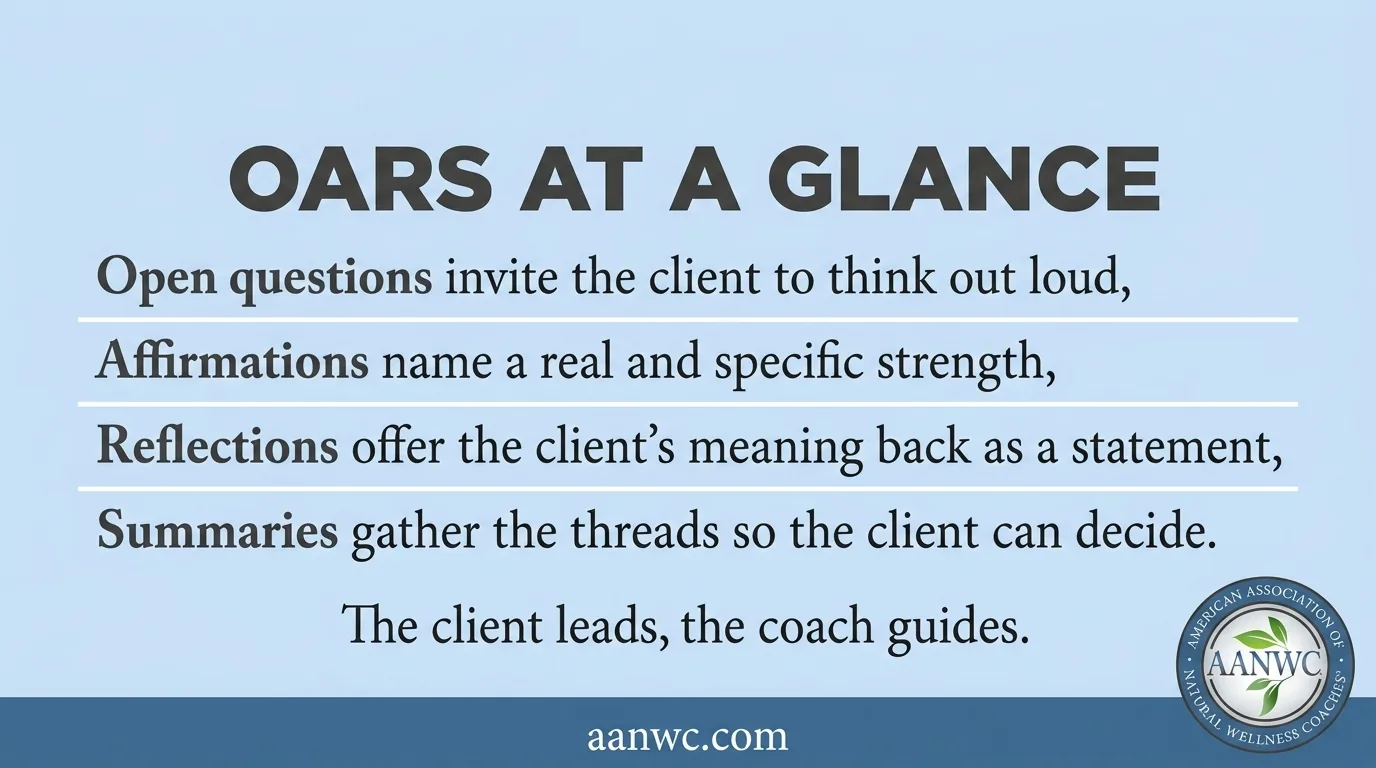
The coaches who move conversations like this forward rarely do it by pushing harder. They do it by changing what they are doing with their attention. Motivational interviewing gives that shift a name and a shape, and most of its everyday usefulness lives in four skills that fit under one short acronym: OARS. Open questions, affirmations, reflections, and summaries. None of them are complicated on their own. What makes them worth practicing is how they work together to keep the client doing the talking, the thinking, and eventually the deciding.

OARS is not a script, and it is not a sequence you run from top to bottom. It is a set of moves you reach for as the conversation calls for them, the way a good listener already does in their best unguarded moments. The value of naming the four is that you can practice each one on purpose, notice which you lean on and which you neglect, and reach for the right one when a session stalls. What follows is each skill in the language of an actual conversation, with the small adjustments that separate a question that opens a door from one that quietly closes it.

Open Questions: Widening the Door
A closed question asks the client to confirm or deny something you have already decided is the point. “Did you manage the walks this week?” can be answered with a single word, and that word is usually the one the client thinks you want to hear. An open question hands the floor back. “What did movement look like for you this week?” invites a story instead of a verdict, and the story is where the useful material lives. The shift is small on the page and large in the room.
The most reliable open questions begin with “what” or “how” and steer away from “why.” “Why did you skip the walks?” sounds like a request for an explanation, and most people hear a request for an explanation as a request for a defense. “What got in the way?” or “How did the week unfold?” asks for the same information without the faint accusation. The client can describe the rushed mornings and the pulling dog as facts to look at together, rather than failures to account for.
Open questions also set the depth of the conversation early. A session that opens with “How are things since we last met?” tends to stay on the surface, because the question is broad enough to answer with “fine.” A session that opens with “What has been on your mind about your energy this week?” points the client toward the specific territory you are there to explore. You are not interrogating; you are widening the door and letting the client choose what to carry through it.
A stalled exchange often turns on a single reworded question. A coach who asks, “Do you think you can fit the walks in next week?” has handed the client a yes-or-no gate, and a discouraged client will usually choose no. The same coach who asks, “What would have to be true for a walk to fit into one of your days next week?” invites the client to start solving the problem out loud. The information that follows, the school run that ends at a certain hour, the half hour that is genuinely free on Thursdays, is the raw material the client needs to build a plan they can believe in.
Affirmations: Naming Real Strength
An affirmation is not praise, and the difference matters more than it first appears. Praise comes from the coach as a judge: “I am proud of you,” “you did great.” It places the coach in the position of the one who approves, which subtly keeps the client working for the coach’s approval rather than their own goals. An affirmation names something real and durable about the client: their effort, their values, a strength they showed under pressure. “You kept thinking about this all week even when the mornings were chaotic” is an observation the client can keep, because it is about them and not about your opinion of them.
The most useful affirmations are specific. “You are doing well” evaporates on contact. “You found a way to get one walk in on the hardest day of your week, and you noticed how much better the afternoon felt afterward” gives the client a concrete piece of evidence about their own capability. It is hard to argue with a detailed, accurate description of something you actually did. Specific affirmations also model the kind of attention you want the client to pay to themselves, which is part of the long work of behavior change.
Affirmations are easy to skip when a session feels behind or a client seems stuck, but those are exactly the sessions where they do the most. A client who arrives discouraged is often discounting every bit of progress they have made. Naming one real strength, accurately and without inflation, can steady the conversation enough for the client to look at the rest of the picture honestly. The point is never to cheer the client up. It is to make sure the true things on their side of the ledger get counted.

The richest affirmations often point at a value rather than a behavior. When a client reschedules a meeting to keep a commitment to themselves, the surface fact is the rescheduled meeting; the deeper truth is that they treated their own health as something worth protecting. Naming the value, telling the client that they decided their wellbeing was worth holding a boundary for, gives them something more durable than a compliment about a single action. Behaviors come and go from one week to the next. A value the client recognizes in themselves tends to stay.
Reflections: The Engine of the Conversation
If OARS has an engine, it is reflection. A reflection is a statement, not a question, that offers back the meaning of what the client just said. The client says, “I want to feel better, but I am so tired by the time I get home.” A simple reflection stays close to the words: “By the evening you are running on empty.” A complex reflection adds a layer of meaning the client implied but did not say outright: “The mornings already ask a lot of you, and by night there is not much left for yourself.” The client hears their own situation described with care, and the usual response is to keep going, to correct you slightly, or to say the thing underneath the thing.

Reflections feel risky to new coaches because they seem to do so little. You are mostly saying back what the client said. In practice they do something a question cannot: they keep the client in the chair with their own experience instead of handing them a task. Research on change talk, the moments when a client voices their own reasons for change, finds that the more a client states the case for change in their own words, the more likely that change becomes. Reflections are the skill that draws that change talk out, because a well-aimed reflection invites the client to say more about the part of themselves that wants something different.
The most quietly powerful version is the double-sided reflection, which holds both halves of a client’s ambivalence in one sentence without taking a side. “Part of you is exhausted by the idea of adding one more thing, and part of you is tired of feeling this tired.” Said plainly, with no push toward either half, it gives the client the whole of their own dilemma to look at.
Notice that a reflection is delivered with the voice falling at the end, like a statement, not rising like a question. A reflection that turns up at the end becomes an interrogation, and the client starts defending again instead of exploring. Motivational interviewing has a substantial evidence base across health behavior change, and reflective listening is the skill most consistently at the center of it.
Summaries: Gathering the Threads
A summary is a longer reflection that gathers several threads of the conversation and offers them back as a whole. After ten minutes of a client describing rushed mornings, a pulling dog, an afternoon slump, and a quiet wish to feel like themselves again, a summary collects those pieces: “So the mornings are already full, the evenings leave you depleted, and underneath all of it there is a real pull to get some of your energy back.” Hearing the scattered pieces assembled into one picture helps the client see the shape of their own situation, which is often the moment something shifts.
Summaries do specific work at specific times. A collecting summary, offered mid-session, signals that you are tracking and gives the client a chance to add what you missed. A linking summary connects something the client says now to something they said earlier, which can surface a pattern they had not noticed. A transitional summary closes one part of the conversation and opens the next, often by handing the decision back to the client: “Given all of that, where does it leave you on the walks?” The summary does the gathering; the client does the deciding.
The discipline in a good summary is restraint. It is tempting to slip your own conclusion into the recap, to summarize the client toward the plan you favor. A summary that editorializes stops being a mirror and becomes another argument, and the client can feel the difference even when they cannot name it. The honest summary includes both the reasons for change and the reasons for staying the same, in the client’s own proportions. When the picture handed back is accurate and complete, the client is far more likely to be the one who reaches for the next step.

Worked together across a session, the four skills make a conversation that the client leads and the coach guides. An open question widens the door, an affirmation steadies the footing, reflections keep the client exploring their own experience, and a summary gathers it into something they can act on. The skill is not in performing each move correctly in isolation. It is in sensing, moment to moment, which one the conversation is asking for, and trusting that the client, given room and an accurate mirror, will usually find their own way toward the change they came in wanting.
This kind of attention, staying with a client’s own words long enough for the client to hear themselves think, is the quiet craft underneath good coaching. It is also the kind of work a community of seriously trained coaches keeps sharpening in one another. AANWC supports natural health coaches earning non-exam board certification who practice at this level of care, coaches whose education has been reviewed and whose work has a professional home.