
Health Coach Board Certification: What It Means and How It Supports Professional Clarity
Light comes up in coaching sessions more in late November than at any other point in the year. In one week, a health coach can hear about a pair of amber glasses ordered online, a sunrise alarm clock unwrapped early as a holiday gift, and a red light panel advertised between two podcast episodes. Each one arrives with the same two questions attached: does this work, and should I be using it? The alarm now goes off in the dark, the afternoon fades by five, and the people in a coaching practice want something they can do about it.
A health coach can meet every one of those questions with the same piece of biology. Morning sunlight, light from lamps and screens at night, and red light from a panel reach the body through different pathways and do their work at different times of day. Once a coach understands what each kind of light signals, the product questions become far easier to answer, and the answers turn into habits a client can build without buying anything at all. This article walks through that biology one light at a time and then translates it into a coaching plan.

The Light Sensors That Set the Body Clock
The body keeps time with a master clock in the hypothalamus, a small cluster of cells called the suprachiasmatic nucleus, which coordinates the daily rhythms of hormones, body temperature, digestion, and alertness. Left to itself, that clock runs a little longer or shorter than twenty-four hours, so it needs a daily reset, and light is the strongest reset signal it receives. The signal enters through the eyes, by a route that runs alongside ordinary vision.
In the retina sits a small population of cells called intrinsically photosensitive retinal ganglion cells. They carry a light-sensitive pigment called melanopsin, which responds most strongly to short-wavelength light in the blue-cyan range, around 480 nanometers. These cells report to the body clock how bright the surroundings are and how long that brightness lasts. They respond slowly and add light up over time, so a long stretch of moderate light can matter as much as a brief burst of bright light.
Two features of this system shape everything that follows. The first is timing. Light early in the day tends to move the clock earlier, so a person feels alert sooner in the morning and ready for rest sooner at night, while light late in the evening tends to move the clock later. The second is intensity. The clock responds to how much light reaches the eye far more than to how pleasant a room looks. A gray, overcast morning outdoors delivers many times more light than a well-lit kitchen, even though the kitchen feels bright enough to read a recipe in.
For a health coach, this is the frame for every conversation about light: when the light arrives, how bright it is, and which wavelengths it carries. Each of the three lights answers those questions in its own way.
Morning Light: The Clearest Signal of the Day
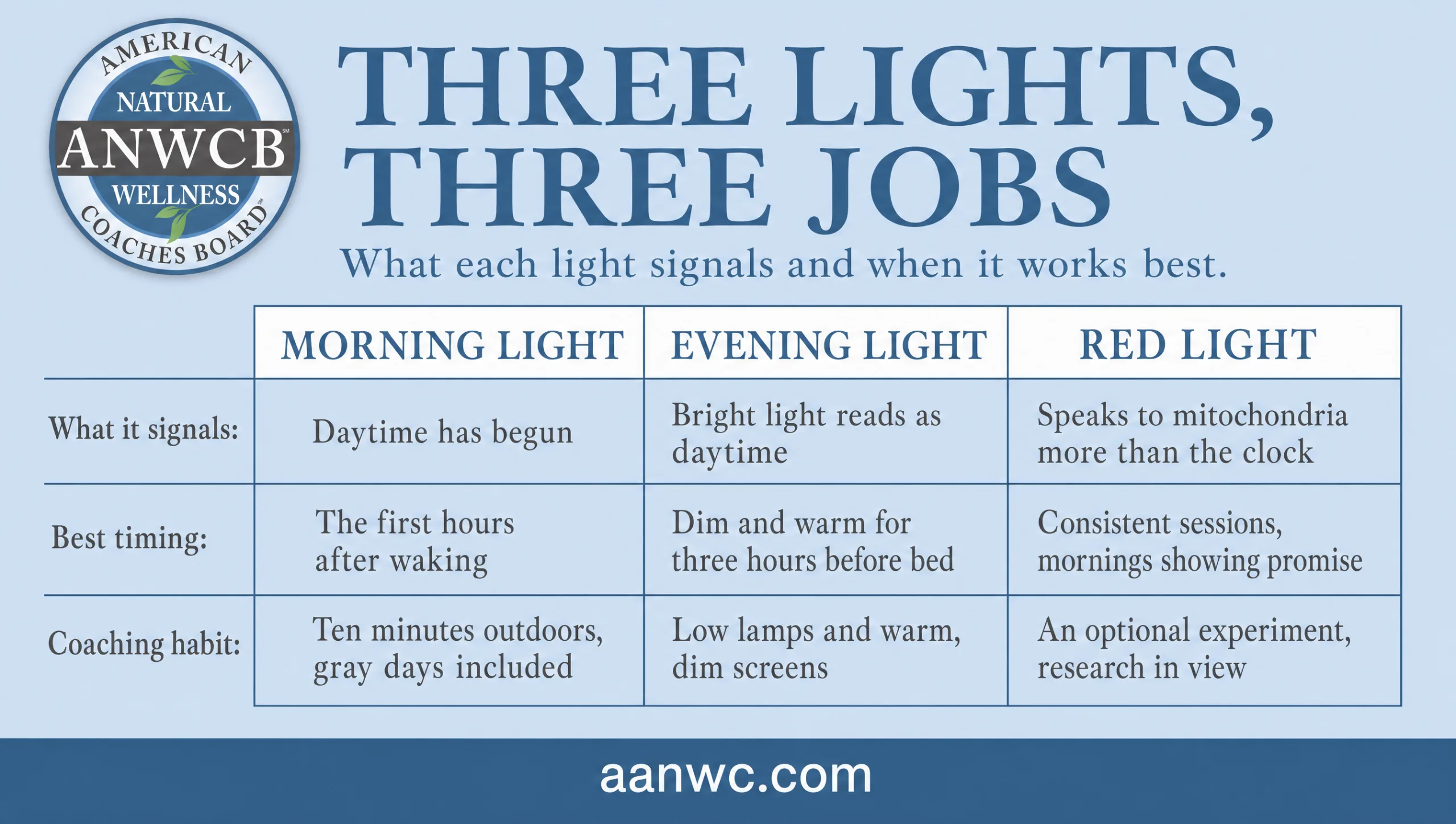
Morning sunlight is the light the circadian system evolved to expect. It is bright, rich in the blue-cyan wavelengths melanopsin responds to most, and it arrives at the time of day when it moves the clock in the most useful direction. In 2022, a group of eighteen circadian and sleep researchers published consensus recommendations for daytime, evening, and nighttime indoor light exposure in healthy adults. They expressed their guidance in a newer unit, melanopic equivalent daylight illuminance, which measures light by how strongly it drives melanopsin. Their daytime recommendation is a minimum of 250 lux of melanopic light at eye level, using daylight wherever it is available.
The number is most useful as a sense of scale. Typical indoor lighting in homes and many offices falls well below it, while daylight outdoors, even under heavy cloud, clears it with room to spare. The practical translation is simple and costs nothing: get outside, or as close as possible to a large window, early in the day, and keep doing it on gray days. Late November is when this habit matters most and when clients feel least inclined to keep it.
Sunrise alarm clocks belong in this part of the conversation. A dawn simulator brightens gradually over the last half hour before waking, and small studies suggest it can make waking feel easier and support morning alertness through the darker months. It works best as a gentle companion to daylight, paired with time outdoors once the day begins, since a bedside lamp reaches far lower levels than the open sky. A client who loves the alarm can keep it, and the coaching work becomes the outdoor habit that follows.
Morning light sticks best when it is attached to something already happening: a ten-minute walk before opening email, the first phone call of the day taken outside, or a dog walk moved half an hour earlier. A client who works from home can turn the first meeting into a walking call, and a commuter can step off the bus one stop early. The research rewards consistency more than heroics, so a modest habit that survives the holiday season is worth more than an ambitious plan set aside by December.

Night Light: Brightness First, Then Color
Evening is where the same biology runs in the other direction. Light in the hours before bed reads to the clock as daytime, nudging its timing later and holding back the evening rise of melatonin, the hormone that tells the body night has arrived. The 2022 consensus recommendations set a maximum of 10 lux of melanopic light in the evening, beginning at least three hours before bedtime, and a maximum of 1 lux in the sleeping environment, which they describe as best kept as dark as safely possible.
This is the point where product marketing tends to narrow the story to a single color. Blue light from screens has become the headline, and with some reason, since screens sit close to the eyes and are rich in short wavelengths. The biology points to a wider picture. Melanopsin responds to brightness and duration as well as color, so a bright white ceiling fixture in the kitchen at nine in the evening can send a stronger daytime signal than a dimmed phone held at a comfortable distance. Brightness comes first, color second, and both matter.
That wider picture lets a coach answer the blue-light glasses question with precision. The lenses come in two broad families. Clear or lightly tinted lenses sold for daytime screen comfort filter a modest share of blue light and are designed around how the eyes feel during long screen hours.
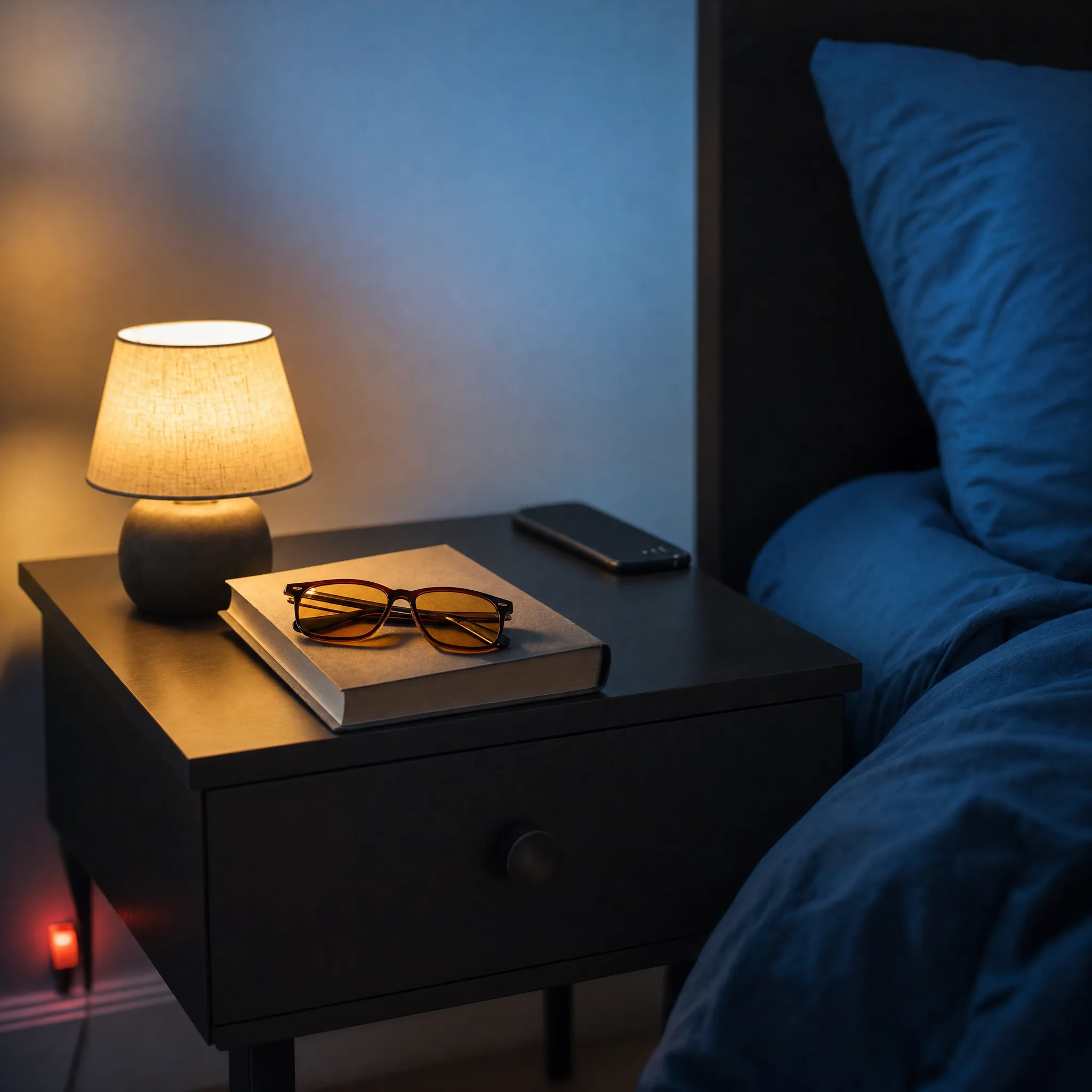
Amber or orange lenses worn in the evening filter far more of the short-wavelength range, and several small trials of evening amber lenses have reported encouraging results for winding down and falling asleep. For a client who wants to use glasses, the biology favors amber lenses in the evening hours, worn in a home that is also growing dimmer.
The evening habits that follow are concrete. Dim the main rooms as the evening begins, using low lamps placed below eye level. Set screens to their warmest color setting and their lowest comfortable brightness, and hold them farther from the face. Choose evening activities that need only soft light, such as conversation, music, stretching, a bath, or a paper book under a small reading lamp. Keep the bedroom dark enough that a hand held out in front of the face is hard to make out. Each one asks the evening to look more like evening.
Red Light: A Young Field With Encouraging Findings
Red light works through a different mechanism from the other two. The melanopsin cells that set the body clock respond only weakly to long red wavelengths, which is why dim red light has long been the light of choice wherever people need to see at night while keeping their rhythms steady. Red light therapy, also called photobiomodulation, turns its attention to a different target altogether: the mitochondria inside cells.
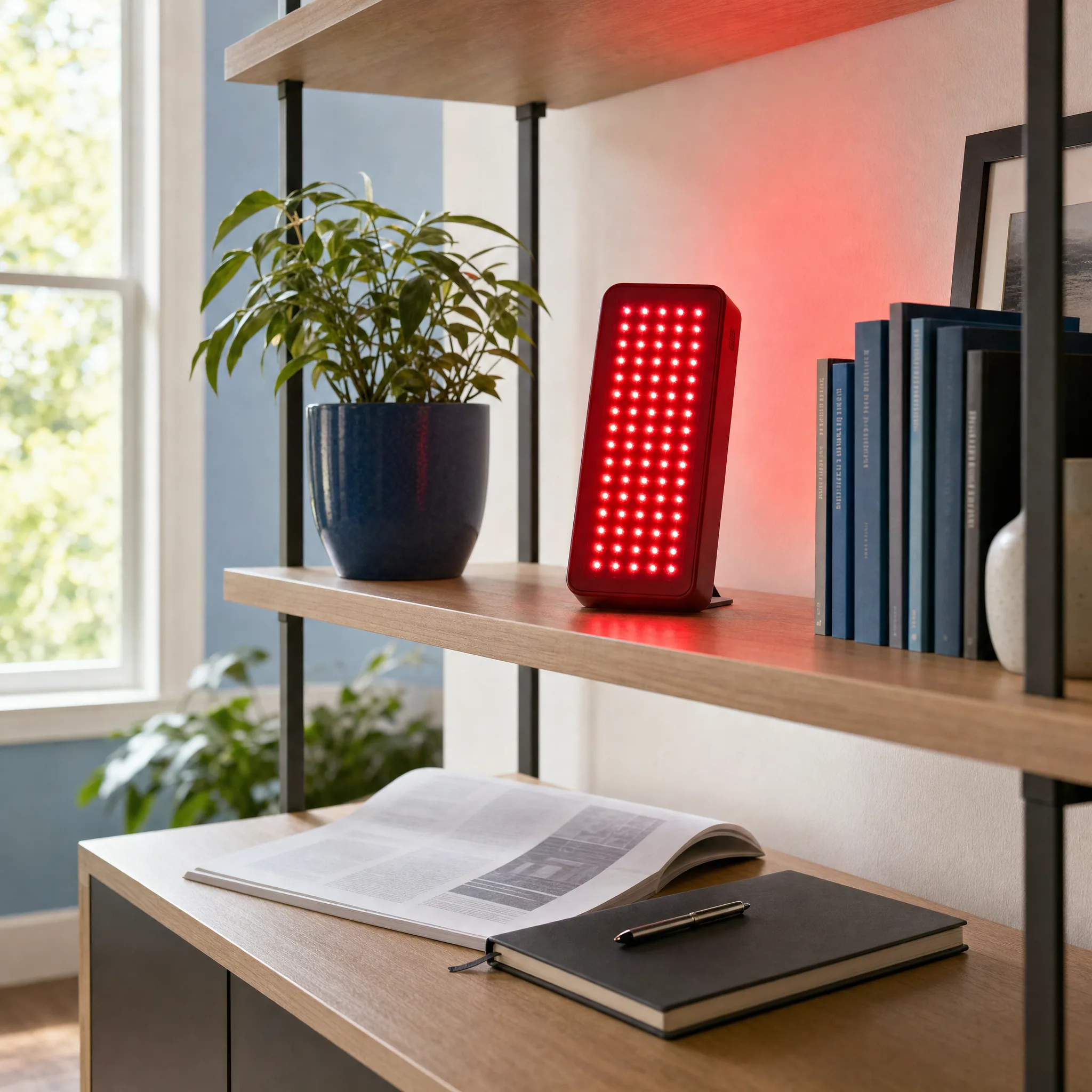
Photobiomodulation uses red and near-infrared light, roughly 600 to 1,100 nanometers. In a 2017 review of photobiomodulation mechanisms, Michael Hamblin described cytochrome c oxidase, an enzyme in the mitochondrial energy chain, as a primary absorber of this light. Absorption is associated with greater production of ATP, the energy currency of the cell, along with a brief signaling burst of reactive oxygen species and a release of nitric oxide, which together switch on pathways linked to cell repair and calmer inflammatory signaling. The same review describes a biphasic dose response, in which low and moderate doses stimulate and higher doses can have the opposite effect. More light and better light are two different things.
One of the most interesting recent findings ties red light back to timing. Researchers at University College London found that a single three-minute morning exposure to deep red light at 670 nanometers improved color contrast vision in adults aged 34 to 70 by an average of 17 percent, with the improvement lasting at least a week in those retested. The same exposure given around midday produced no improvement. The study was small, with twenty people in the morning group, and the authors described their data as variable and called for larger samples. It still points somewhere worth watching, because the researchers linked the timing effect to daily shifts in mitochondrial activity.
Research on red light for skin appearance, exercise recovery, and joint comfort has grown quickly over the past decade, and many of the results are encouraging. It is a young, growing field. Studies vary in wavelength, dose, distance, and session length, many samples are small, and consumer devices differ widely in the light they deliver, so much remains to be discovered about which settings produce which effects. The clear summary a coach can offer is that the mechanism is real, the early findings are promising, and the best-supported results come from specific doses that a home device may match only in part.
This is where coaching scope does its best work. A health coach can share what the research reports, help a client think through cost, consistency, and expectations, and keep curiosity alive. A client who hopes a red light device will help with a health condition is best served by a conversation with their own healthcare provider, and the coach can help that client prepare good questions for it. The coach supports the habits around the device in the same way the coach supports the habits around a morning walk or a dim evening.
Building the Three Lights Into a Coaching Plan
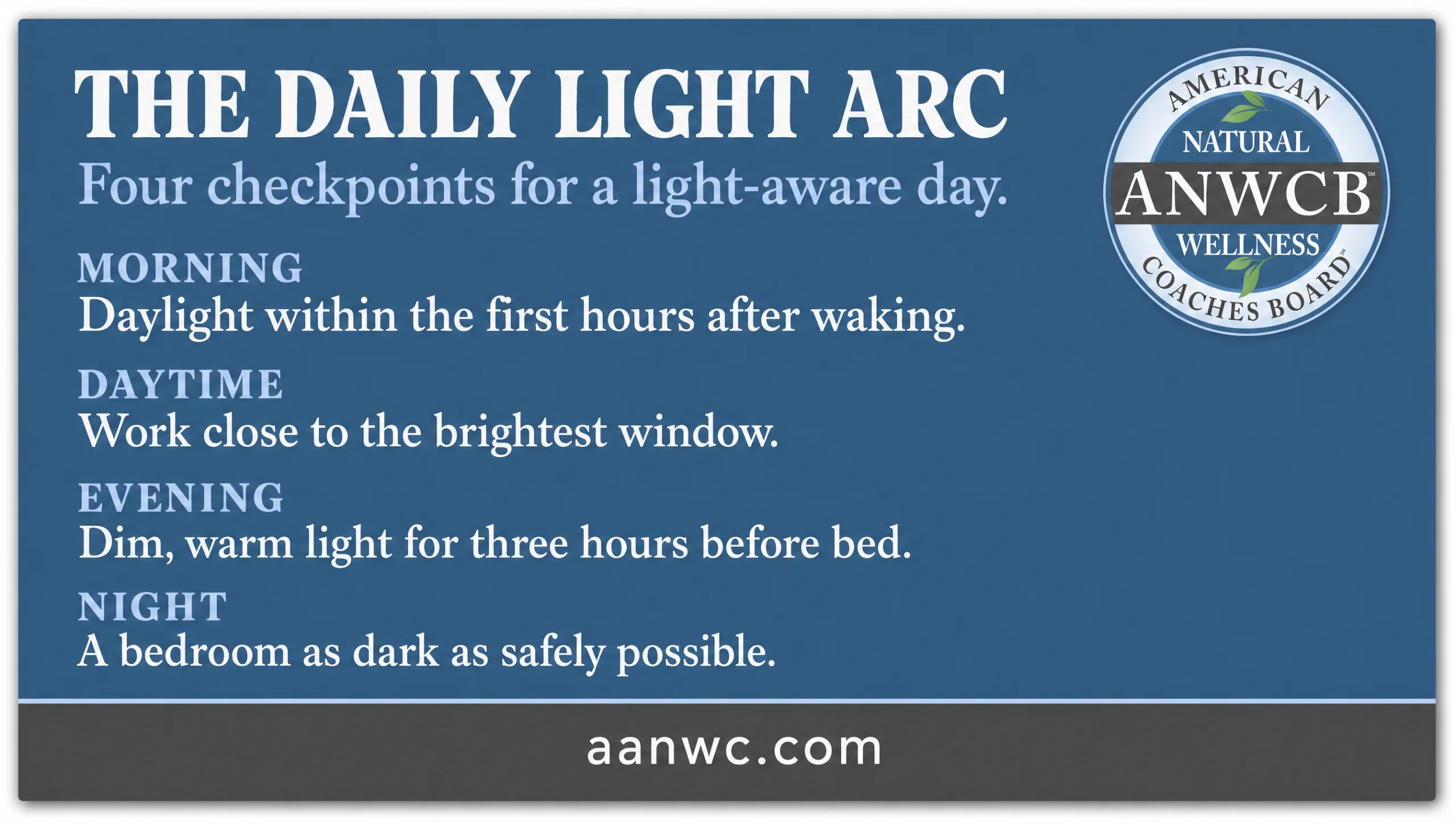
Put together, the three lights form a simple daily arc a client can remember: bright and early, dim and warm at night, and red light as an optional addition with the research in view. A coach can turn that arc into a plan one habit at a time, starting wherever the client already has momentum.
Start with the morning, since it costs nothing and carries the strongest research. Agree on one daylight habit, attach it to an existing routine, and check in on it the following week. Once that habit holds steady, move to the evening and choose one change: dimming the main room at a set hour, scheduling screens to shift to their warm setting automatically at sunset, or moving the phone charger out of the bedroom. Each change is small enough to keep through the holidays.
Products fit into the plan as tools in service of a habit, and three questions keep the conversation grounded. What is this light meant to signal to the body? Does the timing of use match that signal? Which daily habit will this product sit beside? A sunrise alarm fits beautifully when it leads into time outdoors. Evening amber lenses fit well in a home that dims after dinner.
A red light panel used at a consistent time, with expectations matched to the research, makes a reasonable personal experiment. The coach keeps the biology at the center and the client in charge of the choices.
Tracking helps all three. A simple light log kept for one week, noting minutes outdoors before noon and the time the main lights dim each evening, gives the client a clear picture and gives the coach something concrete to build on. Where a client describes persistent daytime fatigue, low mood through the darker months, or other concerns that continue alongside steady habits, the coach refers the client to an appropriate healthcare provider and keeps supporting the daily routines next to that care.
This kind of evidence-anchored coaching, explaining why morning daylight, a dim evening, and a red light panel each do different work, and keeping the research a step ahead of the label, is the work of a health coach whose knowledge has been tested and whose competency is publicly verified. ANWCB supports health coaches earning exam-based board certification who bring this kind of research precision to every light question a client brings in.