

Holding Space Without Rescuing: The Mechanics of Silence, Presence, and Reflection
A client is eleven minutes into the session and has just stopped talking. She has been building a morning routine for six weeks and it has been holding well enough. This morning she did not get up. She has finished explaining why, her eyes have dropped away from you, and now there is nothing. The silence is four seconds old. It feels considerably longer than that from where the coach is sitting, and it feels that way whether the coach is in a chair three feet away or on a screen in another state.
Something in the coach wants to fill it, and that something is not laziness or thin training. It is care. There is a small adjustment available that would probably help and offering it right now would end the discomfort for both people at once. Most health coaches recognize this moment without needing it described. The useful question is not whether the pull exists. It is what happens to the session, and to the client, when a coach acts on it every time.


Where the Pull Comes From
The impulse has a name in the behavior change literature. William Miller and Stephen Rollnick called it the righting reflex, the automatic move to fix a person’s difficulty because you genuinely want to help. The clinical guidance on motivational interviewing is direct about what it costs: a strongly directive style tends to produce more argument in favor of staying the same, and more friction in the working relationship, than a style that draws out the person’s own reasons for change.
For health coaches, the reflex has an extra hook. Coaching education tends to reward visible helpfulness, and a coach who offers a good suggestion looks competent in the moment. Sitting still while a client struggles appears, from the inside, like doing nothing at all. The internal experience of holding space and the internal experience of failing to help are nearly identical in real time. That is the reason this skill must be built on purpose rather than discovered by accident.
The cost of rescuing is not that the suggestion is wrong. It is usually fine. The cost is that the client leaves having received an answer instead of having produced one, and the answers people produce themselves are the ones that survive contact with a hard week. Rescue also quietly relocates the engine of the work. Once the coach becomes the source of solutions, the client starts arriving with problems rather than with thinking, and the sessions get easier and less useful at the same time.
There is a second cost that arrives later. A client who has been rescued repeatedly forms an accurate belief about the working relationship, which is that the useful thinking happens on the coach’s side of it. That belief is difficult to reverse, because the client earned it honestly. It also tends to surface at the worst possible moment, in the week the client is under real pressure, and the coach is not available, which is exactly the week a method of their own would have mattered most. Coaching that builds capacity has to leave the capacity somewhere the client can reach without you.
Silence Is a Working Tool, Not an Absence
Silence in professional conversation has been examined closely enough that it is a mistake to regard it as one thing. Conversation-analytic research on counseling sessions has looked specifically at what happens in the moment after a client finishes telling something, when neither person takes the next turn. The finding worth carrying into coaching is that the pause is jointly produced. Both people are making it. And in the sessions studied, it is usually the professional who ends it.
That last part deserves a moment. If the pause reliably ends because you ended it, the client never finds out what was on the other side of it. The wider literature distinguishes silences in which the client is working, turning something over, arriving somewhere, from silences in which the client has disengaged and gone elsewhere. Those two look almost identical for the first few seconds and are completely different events.
Reading which one you have is a matter of watching rather than guessing. A working silence usually has movement in it. The eyes go up and to the side, or the shoulders shift, or the breathing changes, or the mouth starts and stops. A disengaged silence goes flat. The face settles, the body stills, and the client is waiting for you rather than working. The practical rule most experienced coaches converge on is to let a working silence run and to gently name a flat one. Several of those signals are harder to catch through a webcam than across a room, since a screen crops the body and flattens small movement, which is a reason to give a remote pause slightly more room rather than less.
Naming a flat silence is a small move and it does not need to be clever. Something plain does the work: you have gone quiet, and I am not sure whether you are thinking or whether my question missed. Both readings are offered, neither is delivered as a verdict, and the client can pick up either one. What matters is that the coach names what is happening rather than covering it with new content, because reaching for a fresh question quietly signals that the last one was a mistake and teaches the client that quiet is unwelcome here.
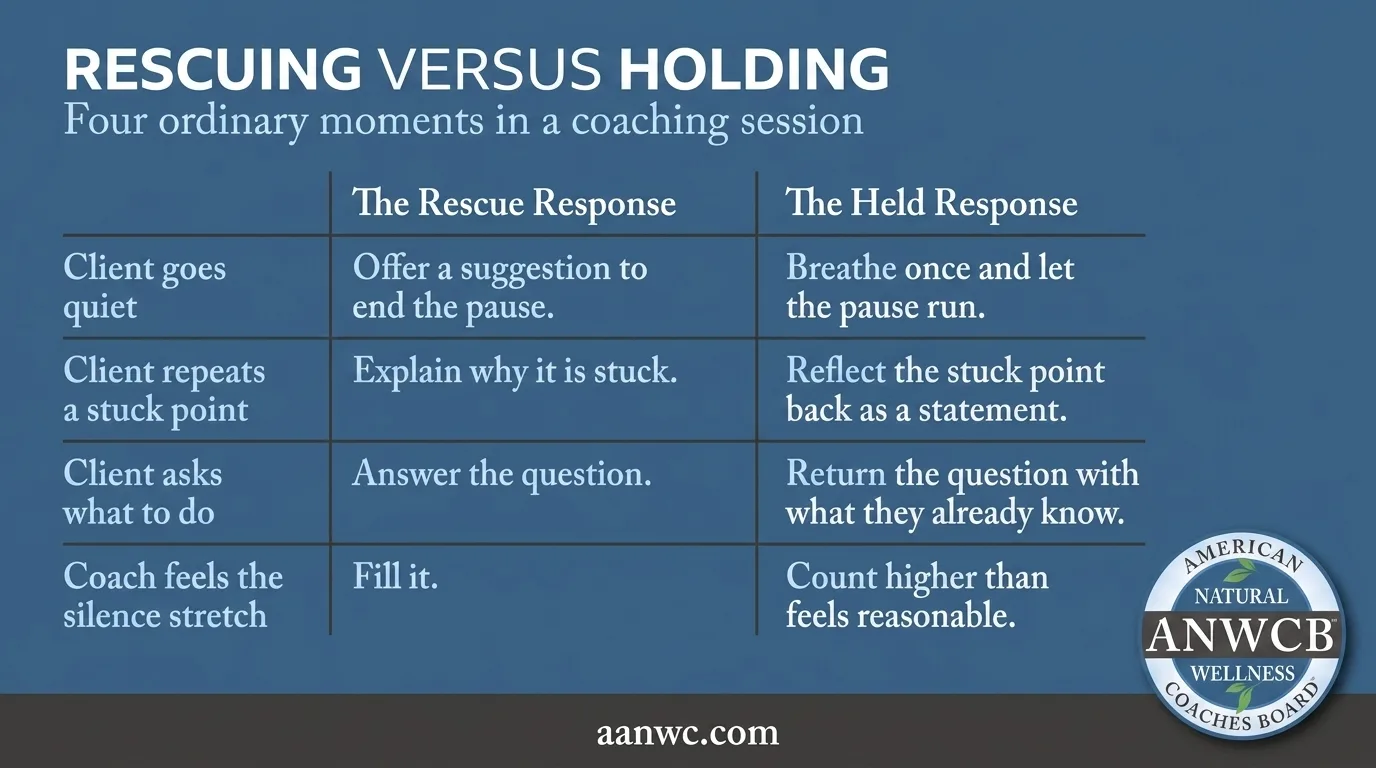
The mechanics of letting it run are unglamorous. Take one slow breath. Keep your face open and mildly interested rather than concerned, because a concerned face reads as pressure and speeds the client up. Do not lean in, which means not shifting forward in your chair across a room and not moving closer to the lens on a call. Do not write during the pause, since the sound and motion of note-taking work as a turn signal in a room and read as divided attention on a screen. Count if you need to, and count higher than feels reasonable. Coaches who start timing their pauses are routinely surprised to learn that what felt like fifteen seconds was five.
Presence Is a Posture, Not a Mood
Presence gets described in coaching materials in language that makes it sound like a state of mind a coach either summons or does not. In session it is more usefully handled as a set of observable behaviors, because behaviors can be performed on a bad day and moods cannot.
Most of the behaviors hold in either setting. Your body stays oriented forward and slightly open. Your hands are visible and still. Your notes are minimal and taken at moments that do not interrupt, and if you take them at all, you said so at the start of the engagement, so the client is never left wondering.
The rest depends on where the session happens, and the two settings fail in different places. In a room, presence means your chair sits at a slight angle to the client rather than square across a desk, your feet stay planted rather than shifting, and nothing behind the client is pulling at your peripheral vision.

On a call, it means your camera sits close enough to eye level that you are not looking down at the person, your eyes stay with the client rather than drifting to your own image, and nothing else is open on your screen. Divided attention is legible long before the client could tell you what gave it away, and that holds in both rooms.
The behavior that most reliably breaks presence is internal and invisible. The moment a coach begins composing the next question, listening stops. The client is still talking, the coach is still nodding, and the actual attention has moved to a draft. This is the most common failure at the intermediate level, and it is hard to catch because it feels like preparation. The correction is to accept that you will need a beat of quiet to find your next question, and to take that beat openly rather than buying it by half-listening through the end of what the client is saying.
Recorded sessions expose this faster than anything else and recording works in both settings with the client’s agreement in place. A coach reviewing their own session can usually identify the exact moment their attention left, and it is almost always earlier than they remembered.

Reflection Hands the Material Back
Silence and presence make room. Reflection is what fills that room without taking it over. A reflection is a statement rather than a question, saying back what the coach understood the client to mean. The motivational interviewing skill set separates simple reflections, which stay close to what was actually said, from complex reflections, which name the thing sitting underneath it.
A simple reflection for the client who did not get up might be that the routine held all the way until it did not. A complex reflection of the same material might be that something about this particular morning felt different from the others, and she is not yet sure what it was. The first confirms she was heard. The second hands her a question without asking one, which is the point. She now has something specific to work with and no obligation to accept the framing if it is wrong.
Reflections fail in two directions. Too shallow and they read as parroting, so the client says yes and stops. Too far ahead and they become the coach’s interpretation delivered as insight, which is rescuing with better manners. The signal that a reflection landed is that the client keeps going and usually corrects some part of it. The correction is a good outcome. It means the client is doing the thinking and using you to sharpen it.
None of this amounts to agreement. A coach can reflect a client’s reasoning accurately and completely without endorsing it, and that separation is exactly what makes it possible to stay with someone through a decision you would not make yourself.
Frequency matters nearly as much as accuracy. A session built entirely of reflections stalls, and a session built entirely of questions turns into an interview. Motivational interviewing commonly teaches a working ratio of about two reflections for every question, which sounds mechanical on the page and stops sounding mechanical the first time a coach tries it and notices how rarely they actually need to ask anything. The reflection tends to produce the next piece of material on its own. The question is what a coach reaches for when it does not.
Holding Space Is Not Passivity
The most common misreading of this skill is that the coach goes quiet and stays that way. Holding space is not the absence of direction. The coach still opens the session, still holds the agreement about what the engagement is for, still asks the question that moves things, and still closes with something the client is actually going to do. What changes is where the content originates, not whether the session has a shape.
The cleanest way to hold that line is to ask what you are doing with your own answer. A coach who has a solution in mind and withholds it as technique is performing patience, and clients feel the performance. A coach who genuinely expects the client’s answer to be better, because the client is the one who has to live it on a cold Tuesday morning in February, is doing something else entirely. The first is a script and it fails under pressure. The second is a position and it holds.

There is one plain exception, and naming it is not a failure of presence. When what surfaces in a session belongs with a licensed professional rather than in a coaching conversation, saying so directly is the right call and takes about ten seconds.
This kind of restraint in session, letting a silence run its full length and handing a client back their own material rather than filling the space with an answer, is the difference between a coach who has been taught a methodology and a coach who has held it under pressure. It is also what a body of coaches who chose to be tested on their methodology tend to have in common. ANWCB supports board-certified coaches earning exam-based credentialing who work at this level of session craft.