

Both Sides at Once: Coaching a Client Who Wants Two Different Things
Two sentences, four minutes apart, in the same session. The first: the mornings are the only time a walk would fit, and starting next Monday feels realistic. The second, after a question about what the mornings currently hold: the twenty minutes before the rest of the house wakes up is the only quiet stretch in the day, and spending it walking feels like trading away the one thing that already works. Both sentences are accurate. Both belong to the same person, who is not being evasive and is not wasting anybody’s time.
That is ambivalence, and it is the ordinary condition of a person considering a change rather than a sign that something has gone wrong. The pull in the room, though, runs entirely toward the first sentence, because the first sentence sounds like progress and the second sounds like an obstacle. What usually follows is a coach who begins, gently and with good intentions, to make the case for the walk. The session then moves in a direction that feels productive for about ten minutes and produces nothing that survives the week.
Ambivalence Is Not a Motivation Problem
Behavior change research has a plain vocabulary for the two halves of what this client is saying. Statements that lean toward the change are called change talk. Statements that lean toward keeping things unchanged are called sustain talk. A person in the middle of a decision produces both, often within the same minute, and the balance between them is a reasonable read on how ready that person actually is. Counterbalanced reasons on each side is close to a working definition of ambivalence itself.

The error worth naming is hearing this as low motivation. The client in the opening has a great deal of motivation. It is pointed in two directions at once, and both directions lead somewhere the client values. Nobody is defending a bad habit here. Somebody is protecting something real, and the protection is the reason the change has not happened yet.
There is reason to take the second half of that seriously. A meta-analysis of thirteen coded studies covering 1,556 participants examined which kinds of client statements predicted what people did afterward. Sustain talk showed more consistent predictive value than change talk did, and the proportion of change talk relative to the total number of motivational statements was the more reliable marker of what followed. The enthusiasm a client voices for the change is a weaker signal than the reasons that client gives for staying put.
That finding has a direct consequence for the room. What a client says during a session is not only a readout of a fixed internal state. It is partly produced by the conversation itself, which means the way a coach handles the two sides is not a matter of style.
What Taking a Side Sounds Like
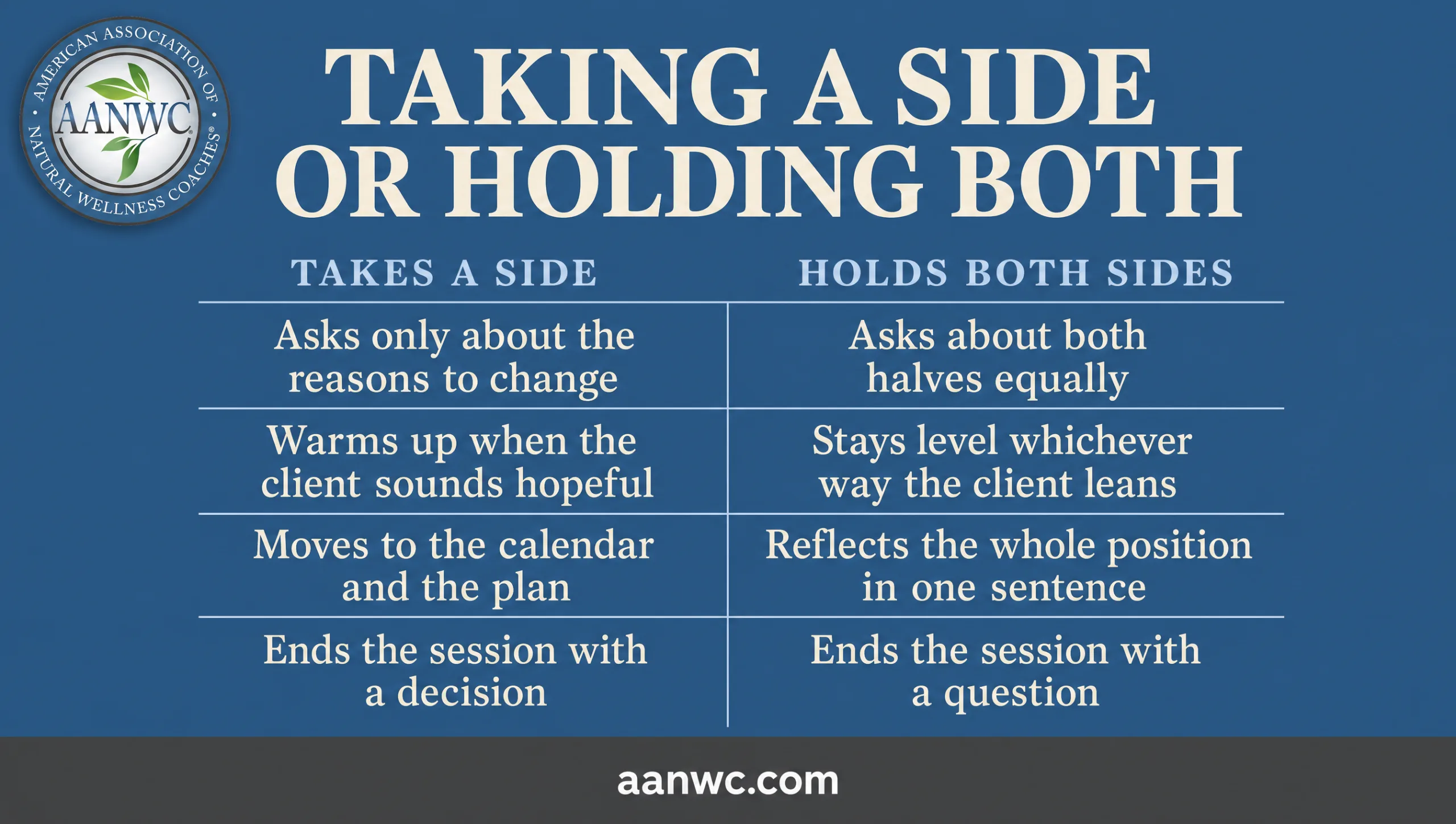
Taking a side rarely announces itself. Very few coaches say the words “you should do this.” What happens instead is smaller and harder to catch. The coach asks one more question about the reasons to change and none about the reasons to keep things as they are. The coach’s voice picks up when the client says something hopeful and flattens when the client backtracks. The coach reaches for the calendar and starts placing the walk in a specific slot on a specific day. The coach says, warmly, “you told me last month this was the thing you wanted most.” Each of those is a vote, and the client registers the vote.
What follows is close to mechanical. When one side of a decision is being carried by somebody else in the room, the other side falls to the client to carry. People also learn what they think by hearing themselves say it, so a client who spends four minutes explaining why the mornings will not work finishes the session more committed to that position than when the session began. The coach did the arguing for the walk. The client did the arguing for the quiet. Only one of those positions got rehearsed out loud by the person who has to live with it.
There is a quieter cost as well. A client who senses which answer the coach prefers starts editing. The second half of the truth stops arriving in session, and the coach ends up working from half a picture, building plans on the strong half and wondering each week why they keep coming apart by Thursday.

The Double-Sided Reflection, Word by Word
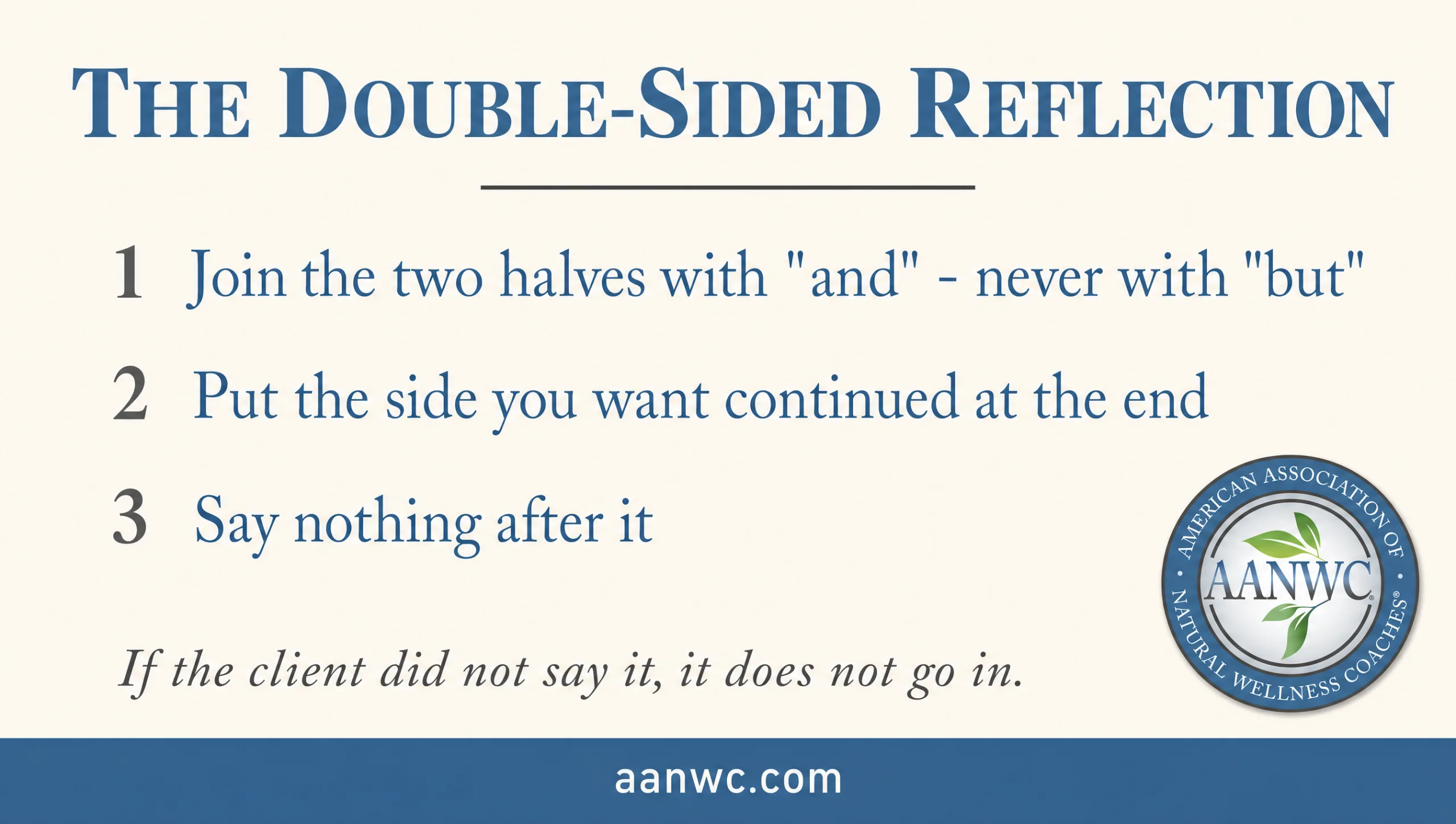
The instrument for this is a reflection that carries both sides in one sentence, in the client’s own terms, with no verdict attached. “You want the mornings to be the time you move your body, and those twenty minutes of quiet are the part of the day you would least want to give up.” Nothing has been solved. Nothing has been argued. The client has heard the whole of their own position stated by somebody who was listening to all of it.
Three details separate a reflection that holds both sides from one that quietly picks one.
The hinge word is “and.” Swap in “but” and the sentence changes jobs, because whatever follows “but” is the clause that survives. “You want the mornings to be the time you move your body, but the quiet matters to you” reads as a concession. “You value your quiet, but you want to be walking” reads as a nudge. Neither is neutral, and clients hear the difference even when they could not name it.
Order carries weight for the same reason. The side placed second is the side a client tends to pick up and keep talking about. That is a real editorial choice and it is available to be used on purpose, with one hard limit: if the client did not say it, it does not go in the reflection. A reflection that improves on what the client actually said is persuasion wearing a reflection’s clothes, and it lands as one.
A second example makes the order visible. A client who wants to cook on weeknights and who also gets home at seven, exhausted, has said two things worth reflecting: “Cooking is the piece you would most like to get back, and by seven you have nothing left.” Reverse it and you get “By seven you have nothing left, and cooking is the piece you would most like to get back.” Same words, same accuracy, different last note, and the client will almost always continue from wherever the sentence ended. Choosing that ending is legitimate. Adding a reason the client never offered is not.
The third detail is what comes after, which is nothing. Let the sentence sit. The common failure here is following the reflection with a question that already contains the plan, such as “so what would it take to do both?” That is a plan with a question mark attached. When the client does pick the conversation back up, the useful move is to ask for elaboration on the reasons the client gives for moving, while acknowledging the other column without inviting more of it. Acknowledging and inviting elaboration are different acts, and the distinction is most of the skill.
The Two-Column Exercise Has a Narrow Window
Almost every coach has run the pros-and-cons sheet, the page divided down the middle with reasons to change on one side and reasons to stay as things are on the other. It feels even-handed, which is exactly why it feels safe. The research record on it is more specific than its reputation suggests.
A review of the evidence on the pros-and-cons procedure reports three findings that matter to a working coach. With people who are still deciding, running the exercise tends to reduce commitment to the change rather than build it. In a series of four experiments, commitment dropped for participants who had not yet decided whether to pursue a goal and rose for participants who had already decided. In a randomized trial with 509 heavy drinkers, motivational interviewing on its own reduced consumption relative to comparison conditions, while the version that added the pros-and-cons exercise did not separate from controls at all. The trial’s authors noted that completing the sheet had reminded participants of what they gained from drinking.
Two cautions belong with those numbers. This evidence comes from counseling and brief-intervention research on drinking and similar behaviors, not from coaching sessions about morning walks, and the populations are not the same. The mechanism it describes, a person talking themselves back toward a position they have just voiced at length, is not specific to that setting, but a coach reading these findings should hold them as direction rather than as proof about a coaching room.
The exercise does have its windows. The reviewers name neutrality as its proper use: when the coach genuinely has no preferred outcome, when the client is choosing between two acceptable paths and the coach has no business steering, an even-handed page is precisely the right tool. It also fits after a decision has been made, where revisiting both sides appears to consolidate commitment rather than dissolve it. What it is not is a warm-up exercise for a client who has not decided yet.
So the question to answer before reaching for the sheet is not whether the client is stuck. It is whether the coach is neutral. Those are two different situations that call for two different sessions.
Slowing the Session Down on Purpose
Say the ambivalence out loud, and say it as a normal feature of deciding rather than as a problem on the agenda. Something as plain as “you have got two real things here, and they both count” changes the temperature, because it tells the client that the second half of the truth is welcome in the room.
Then resist the close. The pressure to end a session with a plan is enormous, and a plan built on one side of an unresolved decision is the plan that generates next week’s report that nothing happened. A half-owned plan is worse than no plan, because it hands the client evidence of failure that belongs to the coach’s timing.
A session that ends without a decision still ends somewhere. It can end with a task that requires no decision at all: notice, over the next week, which mornings the quiet actually happens, and what the rest of the day looks like when it does. It can end with a question to sit with. It can end with an agreement to come back to it. Across sessions, the thing to track is which reasons the client returns to unprompted, because those are the ones with weight behind them. None of this is passivity.

Holding both sides is active work, and it is harder than advocacy, because advocacy gives the coach something to do while holding requires the coach to stay useful without resolving anything. The client resolves it. The coach makes the room in which that becomes possible, and then keeps quiet long enough for it to happen.
Holding both sides of a client’s ambivalence without arguing one of them takes deliberate attention to which words are used and in what order they arrive. That is session craft, and it is learned, practiced, and tested rather than picked up along the way. ANWCB supports health coaches earning exam-based board certification who work at this level of session craft.