

Self-Kindness, Common Humanity, and Mindfulness: How Self-Compassion Keeps Behavior Change Going
The check-in message comes in on a Sunday evening, two weeks into a new plan: “Packed a lunch the first three workdays, then a late night, no lunch, the drive-through the next day, and after that the week felt gone anyway. Maybe this is not the right time for me. Should we pause until things calm down?” Most health coaches have read some version of that message. The plan was reasonable and the client was motivated. One day went off course, and by the end of the week the whole effort was up for reconsideration.
What happens in the next session decides a great deal. A coach can lower the target to something the client cannot miss, which protects the client’s mood and quietly shrinks the goal. A coach can restate the plan more firmly, which keeps the goal intact and often adds to the weight the client is already carrying. There is a third option, which keeps the target where it is and changes how the client responds to the missed day. Kristin Neff’s model of self-compassion describes that response in three parts, and each part gives a coach something specific to say and do in session.

Why One Missed Day Ends So Many Plans
The pattern in that message has a recognizable shape. A plan is held as a rule, the rule is broken once, and the break is read as proof that the whole plan has failed. People who study dieting and habit change sometimes call this the what-the-hell effect: once the day is spoiled, there seems little reason to protect the rest of it. The missed lunch itself costs very little. The reading of the missed lunch costs the week.
Underneath that reading there is usually a harsh internal voice, along with a belief that the voice is useful. Many clients assume that if they stop criticizing themselves, they will stop trying. The research points the other way. In an overview of self-compassion research, Neff and Mary Knox write that self-compassionate people aim just as high as people who are harder on themselves, while accepting that they will not always reach their goals. They describe self-compassion as the opposite of passivity, self-pity, and self-indulgence, which makes it a useful reference for the client who worries that kindness will make them lazy.
Experimental work supports the same point. Across four experiments on self-compassion and self-improvement, Juliana Breines and Serena Chen found that people guided toward a self-compassionate view of a personal weakness, a past mistake, or a failed test were more motivated to improve, not less. In one experiment, participants who failed a difficult first test and were then encouraged to respond with self-compassion spent more time studying for the next one than participants in the comparison conditions. For a health coach, the lesson is practical. Easing a client’s self-criticism after a lapse does not ask the client to want less. It removes one of the main reasons the client stops trying.
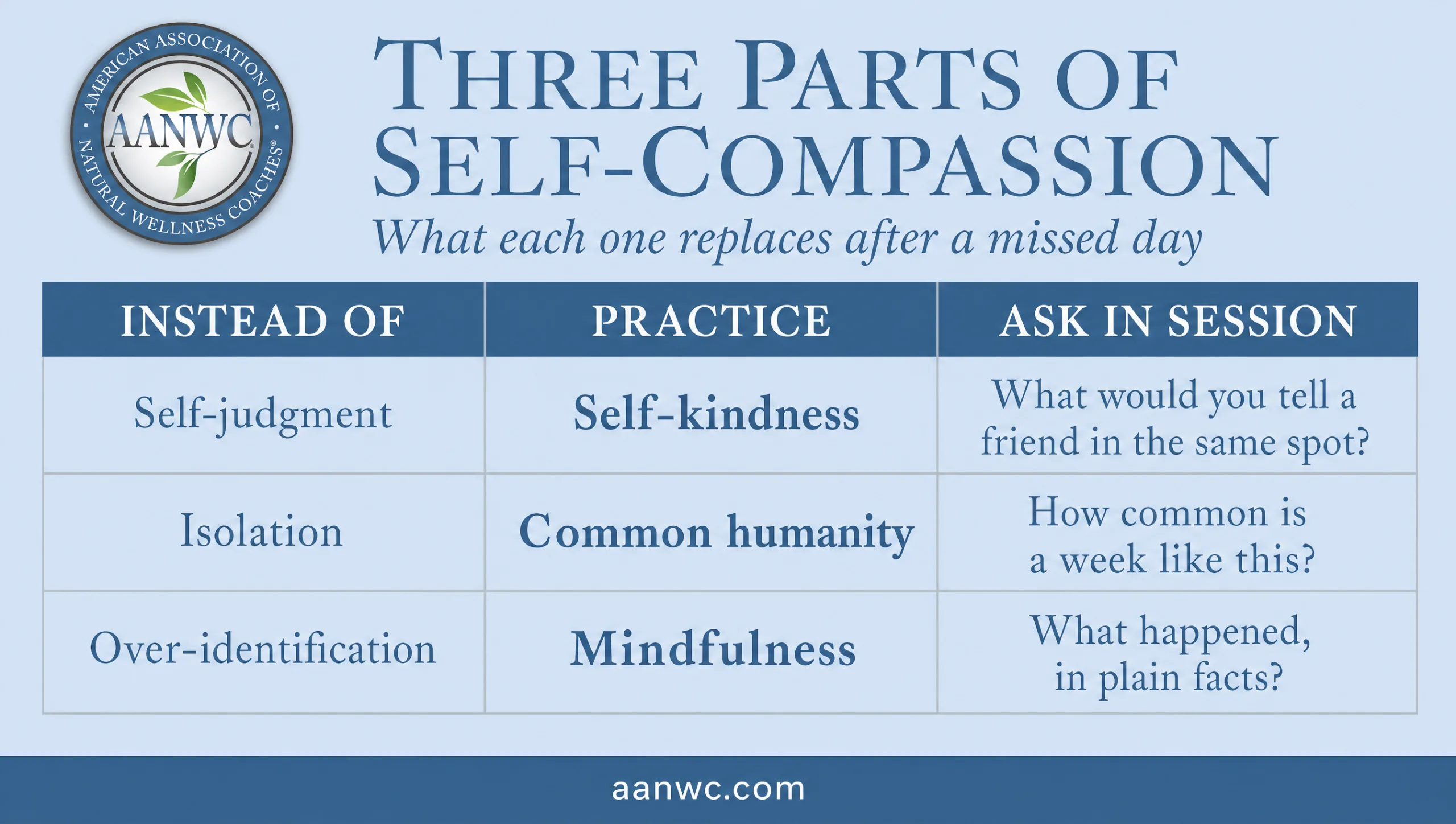
Neff’s model divides self-compassion into three components, each paired with the reaction it replaces: self-kindness in place of self-judgment, common humanity in place of isolation, and mindfulness in place of over-identification. Each one can be taught in session, and each one answers a different part of the message that opened this writing.

Self-Kindness: Replacing the Verdict With a Next Step
Self-kindness means meeting one’s own setback with the warmth and understanding a person would offer a good friend in the same position. In the client’s message, the verdict is easy to spot: the week was gone, and maybe this is not the right time. The judgment is doing the work of a conclusion. It skips past what happened and goes straight to what the lapse supposedly means.
In session, a coach can make that contrast concrete with one question: “If a friend sent you this exact message, what would you write back?” Most clients answer quickly, and their answer is usually both kinder and more useful than what they said to themselves. They tell the friend that one late night does not undo two weeks, that buying lunch once is not a crisis, and that the next workday is a fresh chance to pack one. The coach can then ask the client to read that reply back slowly, as if it were addressed to them.
Self-kindness also changes the questions that follow a lapse. Self-judgment asks what is wrong with me. Self-kindness asks what got in the way and what would help next time. In the packed-lunch example, the honest answer is ordinary: the lunch depended on a quiet evening, and the evening disappeared.
That points to a change the client can test, such as packing two lunches on a calmer night so one is ready for the busy evening, or keeping a few shelf-stable lunch items at work as a backup. The target stays the same. The plan gets sturdier.
A coach can name this shift aloud in plain words: “I am not asking you to go easy on the goal. I am asking you to go easy on yourself so you can get back to the goal.” That sentence often lands because it separates two things the client has fused together, the standard and the self-criticism that was supposed to protect it.
Common Humanity: Making the Lapse Ordinary
The second component answers isolation. When a plan slips, people tend to feel that the slip says something unusual about them: other people manage to pack a lunch, so the problem must be personal. Common humanity is the recognition that falling short is part of the shared human experience, not evidence of a private defect. Neff and Knox describe it as seeing one’s imperfections in light of what all people go through, which replaces the sense of being cut off with a sense of belonging.
For a health coach, this component is where experience with many clients becomes useful, without sharing anyone’s details. A coach can say: “Almost everyone who starts a new routine has a week like this one, usually in the first month. The people who keep going are not the ones who never miss. They are the ones who come back the next day.” That statement is accurate, it is not flattery, and it moves the lapse out of the category of personal failure and into the category of expected events in a change process.
Common humanity also opens a planning conversation that self-judgment tends to close. If a missed day is a normal part of change, it can be planned for ahead of time, the way a coach and client plan for travel, holidays, or a busy season at work.

A useful question is: “What usually happens to plans like this during a hard week, and what would you like your plan to do when that happens?” In the lunch example, the client might decide that a bought lunch after a long evening is part of the plan rather than a break from it, as long as the next workday starts with a packed lunch again. The standard has not moved. The client has stopped reading the first lapse as the end of the effort.

Mindfulness: Seeing the Lapse at Its Real Size
The third component is mindfulness, which in Neff’s model means holding a painful thought or feeling in balanced awareness, neither pushing it away nor being swept up in it. Neff calls the swept-up pattern over-identification. In the client’s message, over-identification shows in how quickly one evening became a statement about the whole week, and then about whether this is the right time to change at all.
A coach can bring mindfulness into the session by slowing the story down and separating events from interpretations. One practical approach is to ask the client to state only what happened, in the plainest terms possible: “One night I got home late, did not pack a lunch, and bought lunch the next day.” Then the coach asks the client to name the thought that followed: “The week is gone.” Seen side by side, the two sentences are clearly different in size. The first describes one meal. The second describes a verdict on a week, and possibly on the goal itself.
Mindfulness also includes acknowledging that the frustration is real. Clients often feel disappointed when a plan slips, and telling them not to feel that way rarely helps. A coach might say: “It makes sense that this was frustrating.
You were proud of those first three days.” Naming the feeling without enlarging it lets the client notice it and set it down, rather than denying it or letting it make the next decision. From there, the coach asks a forward question: “Knowing all of that, what is the next lunch you could pack?” The answer is usually small and specific, and that is the point. Mindfulness returns attention to the next action, which is the one part of the plan the client can still change.
Keeping the Bar Where It Is
The concern running underneath all of this, for coaches and clients alike, is that self-compassion lowers standards. The evidence does not support that worry. In a meta-analysis of 15 samples and 3,252 participants, Fuschia Sirois, Ryan Kitner, and Jameson Hirsch found that self-compassion was positively associated with the practice of health-promoting behaviors in every sample. The association was modest, and part of it ran through emotion: self-compassion was linked with more positive and less negative feeling, and those feelings were in turn linked with healthier behavior. The analysis was correlational, so it cannot show that self-compassion caused the healthier habits, but it fits with the experimental findings on motivation.
What separates self-compassion from letting oneself off the hook is accountability. Letting oneself off the hook means deciding the missed day does not matter. Self-compassion holds that the missed day matters enough to look at honestly, and not so much that it should end the plan. In session, the difference shows in what comes next. A client letting themselves off the hook drops the plan quietly. A client practicing self-compassion reviews what happened, adjusts the plan, and packs the next lunch.
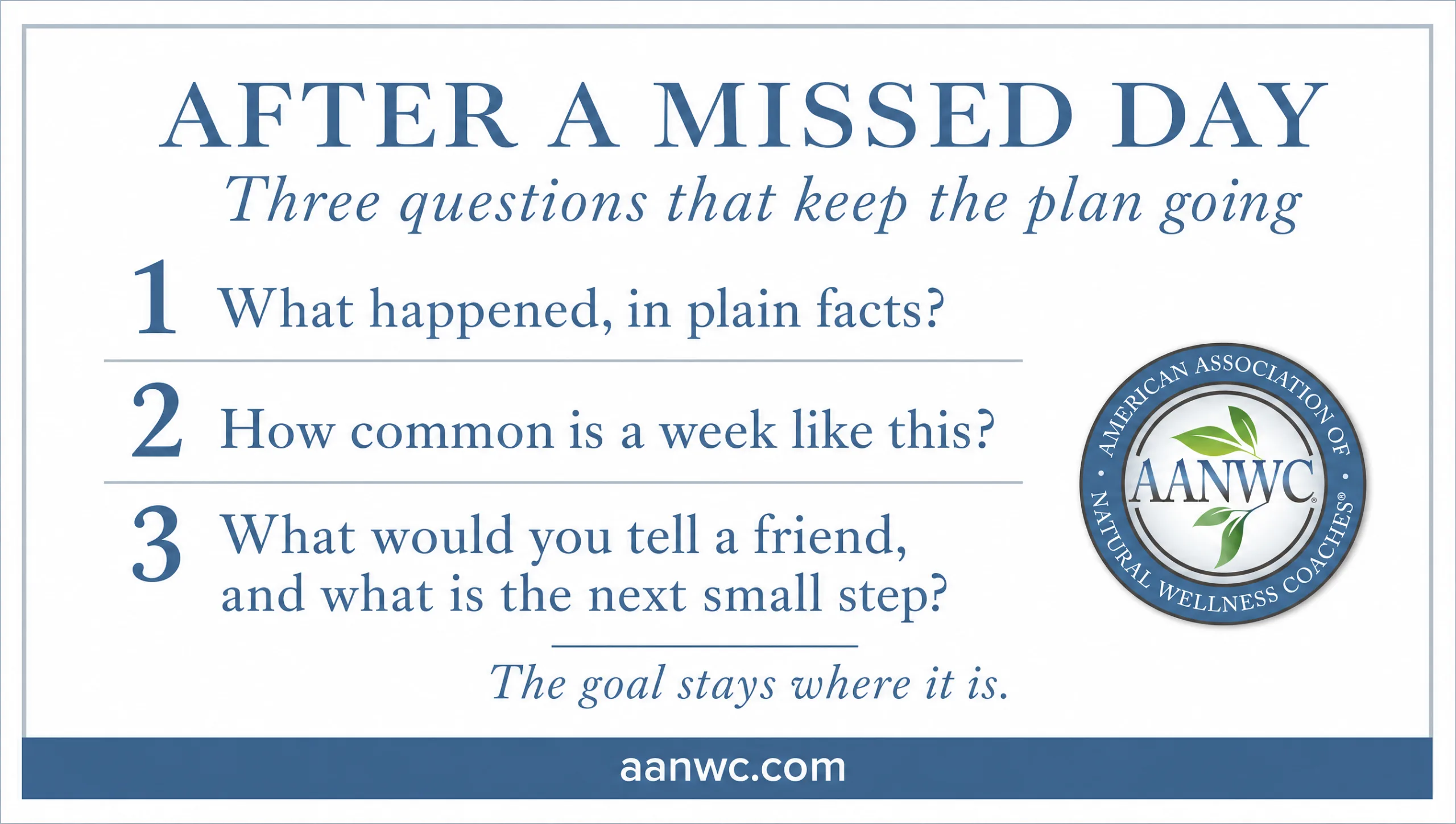
A short session sequence brings the three components together after any lapse. First, the coach asks what happened in plain facts, which is the mindfulness step. Second, the coach asks how common this kind of week is, which is the common humanity step. Third, the coach asks what the client would say to a friend in the same spot, and what one concrete change would make the next attempt easier, which is the self-kindness step. The sequence takes a few minutes, and it ends with a specific next action and the original target still in place.
This work stays inside the coaching role. Self-compassion in this sense is a behavior change skill applied to habits and plans. If a client’s self-criticism seems persistent, severe, or tied to distress well beyond a missed routine, the right step is a referral to a licensed mental health professional, offered with care and without alarm.
Keeping the target steady while changing how a client responds to the day it slips is what lets a plan survive its first hard week, and it takes careful listening, precise language, and a steady conviction that a missed day is information rather than a verdict. AANWC supports natural health coaches earning non-exam board certification who help clients come back to the plan the morning after it slips.