

Coaching, Advising, Consulting: Knowing Which Role You Are In and Saying So Out Loud
Forty minutes into the session, the client stops circling. She has been working the same question for three weeks, whether to keep her workout at five in the morning or move it to the end of the day, and she has just laid out both sides again with the same weariness she brought last time. Then she sits back and says: what would you do? And the coach answers. Six sentences, thoughtful, well informed, drawn from years of watching people try both. The client writes it down. The session ends on time and both people leave feeling that it went well.
Something changed in those six sentences, and both of them felt it without naming it. The client stopped working and started receiving. The coach stopped coaching and started advising, and nobody marked the moment. The following week opens with the client reporting on how the coach’s suggestion went, which is a different conversation from the one they had been having for three weeks. That drift is common, and it is rarely a failure of discipline. It is a change of role that nobody said out loud.

Three Roles, Told Apart by What the Client Leaves Holding
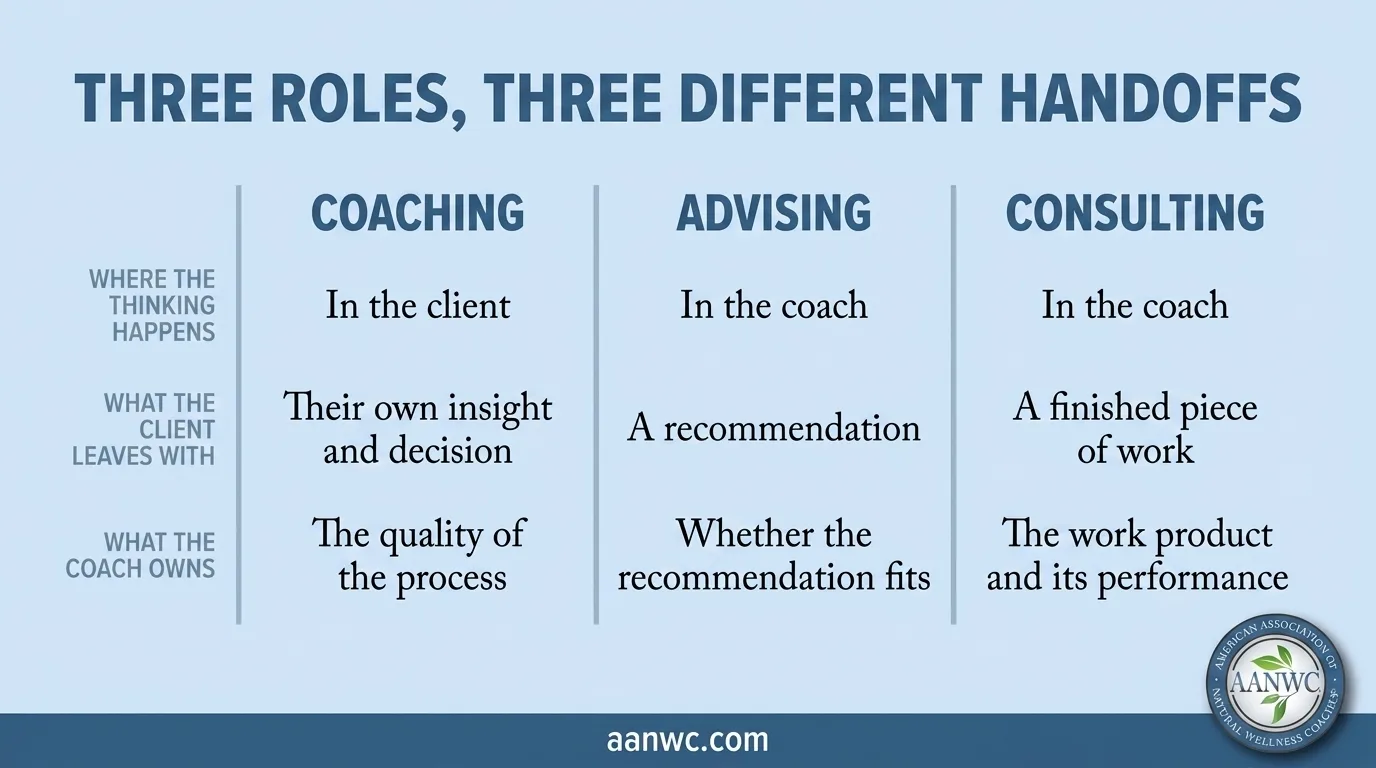
Coaching, advising, and consulting get sorted most often by tone, as though coaching were the gentle version and consulting the blunt one. Tone is the wrong axis. A coach can be extremely direct. A consultant can be warm and unhurried. What actually separates the three is where the thinking happens and what the client walks out holding.
In coaching, the thinking happens in the client. The coach asks, reflects, and holds the line of inquiry, and the client leaves with an insight and a decision that are their own. The peer-reviewed review that read through hundreds of studies to arrive at a working definition of health coaching landed on this same center of gravity: the client at least partly sets the goals, self-discovery works alongside education rather than behind it, and the client self-monitors so that accountability belongs to them (Wolever and colleagues, systematic review). The coach owns the quality of the process. The client owns the content and the result.
In advising, the thinking happens in the coach and transfers to the client as a recommendation. The client leaves holding an answer they did not generate. The coach now owns something new, namely whether that recommendation was accurate and fitting for this particular person. The client still decides whether to act on it, but the origin of the idea has moved across the table.
In consulting, the thinking happens in the coach and so does the labor. The client leaves holding a finished piece of work: a weekly meal framework somebody built for them, a written program, a plan for a small employer’s wellness offering. The coach owns the work product itself and, to a real degree, whether it performs.
Written out this way, the three look easy to tell apart. Inside a live session they are not, because the move from the first to the second takes about four seconds and almost always arrives disguised as generosity.

When Advising Is the Right Move
Many coaches learn early that advising is the thing to avoid, and the lesson lands so firmly that any move toward giving information starts to feel like a lapse in craft. It is not. Advising is a different role, and there are conditions under which it is the correct one to be in.
The clearest of those conditions is informational. The client lacks something they cannot reasonably generate through reflection. No question, however well built, will surface what soluble fiber is, or what separates two forms of the same mineral on a supplement label, or how long a shift in sleep timing usually takes to settle. Asking a client to discover a fact they simply do not have is not coaching. It is theater, and clients can feel it happening.
A second condition is the direct request paired with honest limits. When a client asks something a health coach genuinely knows, and the answer sits inside general wellness education, giving it plainly is service rather than failure. When the question reaches past that line, no amount of careful role-naming changes the answer. Interpreting a lab panel, naming a condition, or shaping a course of care for a diagnosed illness belongs to a different kind of professional, and the honest move is to say so and help the client get there.
The third condition is that inquiry has genuinely run out. A coach who has asked four good questions and watched the client circle the same three sentences each time is no longer being patient. At that point the useful move may be to offer something, clearly marked as an offer rather than a verdict, and then hand the evaluation of it straight back to the client.
When Consulting Is the Right Move
Consulting slips in even more quietly than advising, because it does not feel like a change of role at all. It feels like being helpful. The client says they cannot get organized around meals, the coach hears real frustration, and the coach says: let me put something together for you. By the following Tuesday the coach has built a document. The client never asked for a document. The coach volunteered a deliverable, and the engagement converted without either person deciding that it should.
Consulting is legitimate work and often valuable work. Coaches build employee wellness programs, design group curricula, and write plans that clients genuinely want to buy.

The conditions that make it the right role are conditions of agreement rather than conditions of the moment: the client wants the artifact more than they want the process of making it, the deliverable is named and priced before it gets built, and both people understand that the coaching relationship pauses or runs alongside the build rather than quietly becoming it.
When consulting arrives unnamed, two things go wrong at once. The coach absorbs production work that was never priced, which is the visible cost and the one coaches usually notice first. The less visible cost is that the client begins waiting. The rhythm of the engagement changes from a person doing their own thinking between sessions into a person waiting for the next thing to be handed over, and that rhythm is hard to reverse once it sets.
Why the Drift Happens
The pull toward advising has a name in the behavior change literature. Miller and Rollnick called it the righting reflex: the automatic, well-meant impulse to see a problem and move immediately to fix it. Federal clinical guidance describes the neighboring pattern as the expert trap, where the helper falls into supplying answers and the person across from them settles comfortably into receiving them. The reflex is not laziness. It comes from caring about the person, and from years of being rewarded for knowing things.
What makes it costly is that it tends to produce the opposite of what it intends. When the helper argues the case for a change, the ambivalent person predictably voices the reasons to stay exactly where they are, and the conversation hardens. Work joining motivational interviewing with self-determination theory frames the same effect in terms of where motivation lives: when the reason for a change sits in the helper rather than in the person, the regulation is external, and externally regulated change tends not to hold. The client who leaves with the coach’s plan often has less of themselves invested in it than the client who leaves with a smaller plan they built.
The moment is hard to catch because the immediate feedback is positive. The client asked. The client wrote it down. The client said that was so helpful. Nothing in the room signals a problem. The signal arrives three weeks later, when the plan quietly stops and neither person can say precisely why.
It also rarely arrives as one decision. It arrives as three small ones: a fact offered, then a suggestion offered, then a full recommendation, each a reasonable extension of the last. By the time the coach notices, the session has been an advising session for twenty minutes.

Saying It Out Loud
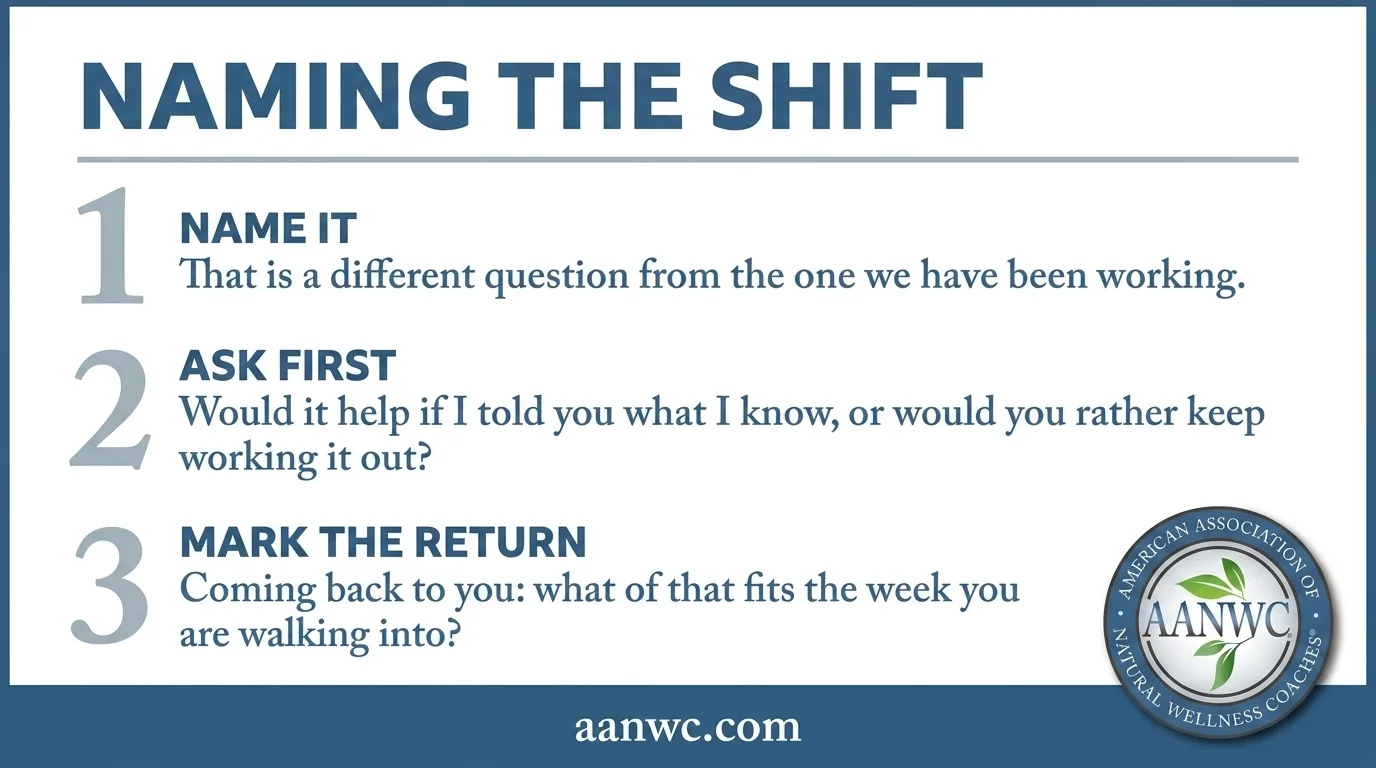
The correction is not to refuse the other two roles. It is to make the change of role audible. Naming it takes roughly fifteen seconds and has three parts.
The first part names the request and marks it as different. Something close to: you are asking me what I would do, and that is a different question from the one we have been working. That single sentence does a surprising amount of work, because it tells the client that the coach noticed and that whatever follows is deliberate rather than accidental.
The second part asks before switching. I am glad to step out of the coaching seat for a minute and tell you what I know about this. Would that be useful right now, or would you rather keep working it out yourself?
Clinical guidance for offering information inside a change conversation follows the same shape: find out what the person already knows and whether they want more, give the information plainly, then ask what they make of it. Asking permission is not a formality. It hands the client the decision about the role change, which keeps them in the position of choosing even while they are receiving.
The third part marks the return. That is the information piece. Coming back to you now: what of that actually fits the week you are walking into? Without this sentence the session stays in the new role by default, because nobody closed the door behind it.
There is also a version where the answer is no. A coach can decline the change of role without declining the client: I could tell you what I would do, and it might be exactly wrong for your mornings, so let us stay with what you already know about them for a few more minutes. And when the request reaches past what a health coach does, the decline is plainer and warmer than most coaches expect it to be. That question deserves someone who can look at your full history properly, so let us get it to your physician, and I will keep working the part that is mine.
Two habits make all of this considerably easier. The first is setting the expectation at the start of an engagement, during the agreement conversation, in one plain sentence: most of our time together I will ask more than I tell, and when you want information from me I will give it and I will tell you that is what I am doing. A client who heard that sentence in week one is not startled by it in week nine. The second habit is writing it down. A short line in the session note recording where the role changed and whether the client agreed to it costs almost nothing and teaches a great deal over time. A coach who reviews a month of notes and finds nine role changes has learned something about their own reflex that no amount of good intention would have surfaced.
This kind of role awareness, catching the moment a question changes what the client is actually asking for and naming it out loud instead of sliding past it, is ordinary craft among health coaches who take the work seriously. It is also almost invisible from the outside, which is part of why an independent review of a coach’s education carries weight: it puts a reviewed professional standard behind judgment that clients have no way to audit for themselves. AANWC supports natural health coaches earning non-exam board certification who hold their role this deliberately.