

Coherent Breathing and HRV: What Your Nervous System Is Telling You
A client sits across from you on a video call at the end of a long day, shoulders drawn up near her ears, describing the meeting that went sideways and the way her chest still feels tight an hour later. You could hand her the advice she has heard a hundred times, breathe deeply, calm down, and watch it land as one more thing she is failing to do. Or you could show her something her own body will confirm within a minute or two, a pace of breathing that changes how her heart is behaving in real time. The second option is the one that changes the session, because it replaces a vague instruction with a skill she can see working.
Most people arrive at breathwork through vague instruction. Take a deep breath. Belly breathing. In for four, out for four. Some of it helps, much of it is guesswork, and almost none of it explains why a particular rhythm of breathing does anything at all. For a health coach who wants to teach breathwork with real physiology behind it, the useful starting point is not the breath itself. It is the nervous system the breath is speaking to, and the single measurement that lets a client hear the conversation.

What Heart Rate Variability Actually Measures
Heart rate variability, or HRV, is the small variation in time between one heartbeat and the next. A heart that beats exactly once per second, metronome-steady, is not the healthy one. A resilient nervous system produces a heartbeat that speeds up slightly on the inhale and slows on the exhale, and that fluctuation, measured in milliseconds, is HRV. Higher variability generally reflects a nervous system that can shift flexibly between effort and recovery. Lower variability, sustained over weeks, often reflects a system stuck in a defensive posture, spending its days braced for something.

The reason HRV matters to a health coach is that it offers a window into the autonomic nervous system, the part running heart rate, digestion, and stress response without conscious input. That system has two broad branches. The sympathetic branch mobilizes energy for effort and threat. The parasympathetic branch, carried largely by the vagus nerve, governs rest, digestion, and recovery. HRV is one of the few signals a client can actually see that reflects the balance between the two, which is what makes it such a useful anchor for a conversation about stress.
It also helps to know what a reading looks like in practice, because clients will ask. Many wearables report a morning HRV score taken during sleep, often built on the beat-to-beat differences that track vagal activity, a measure researchers abbreviate as RMSSD. The exact number matters far less than a coach might assume. HRV is deeply individual, shaped by age, fitness, genetics, and sleep, so one person’s healthy reading is another person’s off day. What a coach helps a client watch is not a leaderboard against strangers, but the client’s own baseline and how it moves.
Vagal Tone and the Breath
The vagus nerve is the longest of the cranial nerves, wandering from the brainstem down through the throat and chest into the gut. Its influence on the heart is continuous and fast. When vagal activity is high, it applies a gentle brake to the heart, slowing it beat by beat. When vagal activity eases, the brake releases and the heart quickens. Vagal tone is the term for how strong and responsive that braking capacity is, and it is closely tied to the HRV a client records.
Here is where breathing enters, and where the physiology becomes something a coach can teach with confidence. The vagal brake is not applied evenly across the breath. It strengthens on the exhale and eases on the inhale. That asymmetry is why the heart naturally speeds slightly as a person breathes in and slows as they breathe out, a pattern with the unwieldy name respiratory sinus arrhythmia. The breath is one of the only autonomic functions a person can take conscious hold of, which means the breath is a direct handle on vagal activity. Slow the exhale, lengthen the window in which the vagal brake is engaged, and the parasympathetic branch gets more of the say.
This is also why chronic stress shows up in the body the way it does. A nervous system that spends most of its hours leaning sympathetic keeps the vagal brake mostly off, and the felt result is the client who cannot come down after a hard day, whose sleep is thin and whose resting state is a low hum of readiness. Low HRV over time is one visible signature of that pattern. The encouraging part, and the part worth teaching, is that the same handle that reveals the problem also offers a way to practice the opposite.
Why Coherent Breathing Works
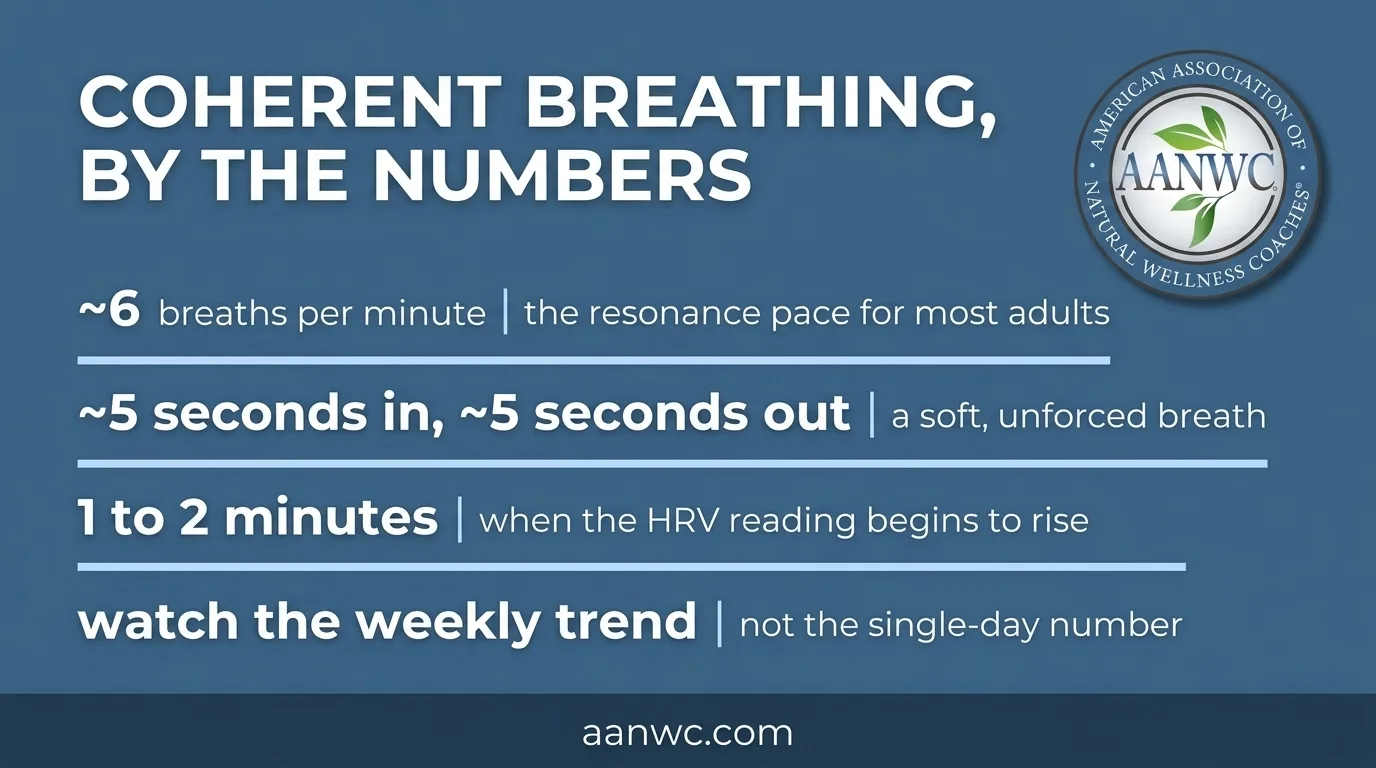
Coherent breathing, sometimes called resonance breathing, is the practice of slowing the breath to a rhythm of roughly six breaths per minute, near a five-second inhale and a five-second exhale. That pace is not arbitrary. Each person has a breathing frequency at which the natural rise and fall of heart rate lines up with the rhythm of the breath, and the two begin to reinforce each other rather than work at cross purposes. For most adults that resonance point sits close to six breaths per minute.
The mechanism underneath is a feedback loop called the baroreflex, the system that adjusts heart rate in response to shifting blood pressure. At the resonance pace, the timing of the breath, the swing of blood pressure, and the baroreflex’s response all fall into step, and the oscillations in heart rate grow large and smooth instead of small and choppy. Breathing at that frequency produces a clear rise in HRV during the practice. A coach does not need to lecture a client on baroreflex physiology, but knowing it is there is what lets a coach answer the honest question of why this pace and not another.
What a client feels is quieter than the physiology sounds. The tight chest loosens. The mind stops sprinting. The sense of being braced softens into something closer to settled. What the physiology shows, if the client is wearing anything that records HRV, is a clean increase in variability that arrives within a minute or two and often lingers after the breathing stops. The value for coaching is that the client does not have to take the calming on faith. The body reports back, and that report is what makes the practice stick.

Teaching It to a Client
The introduction that works best is short and unmystical. You are not asking the client to meditate or to empty the mind. You are asking them to breathe at a specific pace and to notice what changes. A simple starting point is a five-count inhale through the nose and a five-count exhale, ideally with the exhale soft and unforced. Many clients find a longer exhale than inhale even easier to settle into, a four-count in and a six-count out, because the extended exhale leans further into the parasympathetic side. Either works. The pace matters more than the ratio, and the ratio matters more than perfection.
The moment that earns a client’s trust is the first time they watch a number move. A client with a wearable that shows HRV, or even a simple app that graphs heart rate, can breathe at the resonance pace for two or three minutes and see the reading respond. For a client who has spent years being told to relax with no idea whether it was working, that feedback is the difference between another vague instruction and a skill they can practice on purpose. Where a coach wants a plain-language summary of the research to point a curious client toward, the published work on resonance breathing at about six breaths a minute is worth keeping on hand.

The framing to hold onto is that this is education and skill-building, not a remedy for a diagnosis. A health coach teaches a client how their own physiology responds to a paced breath and helps them build the habit of using it. When a client’s concerns point toward a medical condition, or when breathing patterns are tangled up with a health issue that needs a clinician, the clean move is to educate within scope and refer for anything beyond it. Keeping the breath as a coaching tool for regulation and self-awareness, and working within a defined health coach scope of practice, is what keeps the practice both useful and honest.
A few obstacles come up often enough to name in advance. Some clients feel lightheaded when they first slow down, usually because they are pulling in far more air than the slow pace needs. The fix is a smaller, gentler breath, not a bigger one. Others turn the practice into a performance, straining to hit the count and tensing the very system they are trying to settle. And a certain kind of client will start chasing the number, refreshing the app and treating a low reading as failure. A coach heads all three off by teaching an easy breath, a soft exhale, and a long view of the data rather than a minute-by-minute one.
Building the Habit That Sticks
A single good session rarely changes a client’s baseline. What shifts vagal tone over weeks is repetition, the breath practiced often enough and briefly enough that it becomes a reflex the client reaches for without a reminder. This is where a health coach does the work a breathing app cannot. The app can pace the breath. The coach helps the client find the two or three moments in an ordinary day where the practice actually fits, the commute before a hard meeting, the ten minutes after the kids are down, the pause before a conversation the client has been dreading. Anchoring the breath to a moment the client already has is what turns it from a good intention into a habit.
It also helps to give the client a way to watch progress that is not a single day’s reading. HRV bounces around day to day with sleep, alcohol, illness, and stress, and a client who reads too much into one low morning can talk themselves out of a practice that is working. The more useful view is the trend across weeks. A coach who teaches a client to watch the direction rather than the daily number is teaching them to read their own nervous system with the patience the signal actually requires.
Over enough weeks, something larger than a breathing skill takes shape. A client who once experienced stress as weather that simply happened to them starts to notice they have a way to answer it, and that they can watch the answer land. That shift, from bracing against the body to working with it, is the quiet aim behind all of this. The paced breath is the entry point, and the HRV reading is the proof, but the real change is a client who feels less at the mercy of their own nervous system.
This kind of teaching, grounding a simple practice in physiology a client can see and building it into a habit that holds, is the work of a board-certified health coach who takes the science seriously and whose education has been reviewed and recognized. AANWC supports natural health coaches earning non-exam board certification who translate research like this into skills their clients can actually use.