

Self-Compassion Is a Behavior Change Variable: Kristin Neff’s Three Components and Why They Outperform Self-Criticism
A client sits across from you, or on the other side of a video call, and tells you about the week. She had three good days. The plan was working. Then Thursday came apart, the evening unraveled, and by Friday she had decided the whole effort was pointless. She is not telling you about a failure of knowledge. She knows exactly what she was supposed to do. She is telling you about the voice that arrived the moment she slipped, the one that said this always happens, that she has no discipline, that she may as well stop pretending. By the time she reaches you, the lapse is not the problem. How she spoke to herself about it is.
Most coaches are trained to respond to that moment by tightening the plan. Smaller goals, clearer tracking, a firmer accountability framework. Those tools have their place. But there is a variable in behavior change that sits underneath all of them, one that determines whether a client can absorb a setback and continue or whether a single bad day ends a month of progress. That variable is self-compassion, and the research on it is rigorous, not soft.
The reflexive assumption among many coaches, and most clients, is that self-criticism is the engine of improvement. Be hard on yourself and you will do better next time. Go easy on yourself and you will let yourself off the hook.

This belief rarely gets examined, which is unfortunate, because the evidence points consistently the other way. Harsh self-criticism is associated with more avoidance, more procrastination, and more abandonment of goals, not less. Self-compassion, properly understood, is associated with greater persistence, faster recovery from lapses, and a steadier relationship with long-term change. For a coach working at the level of behavior rather than information, understanding why is among the most useful things to carry into a session.
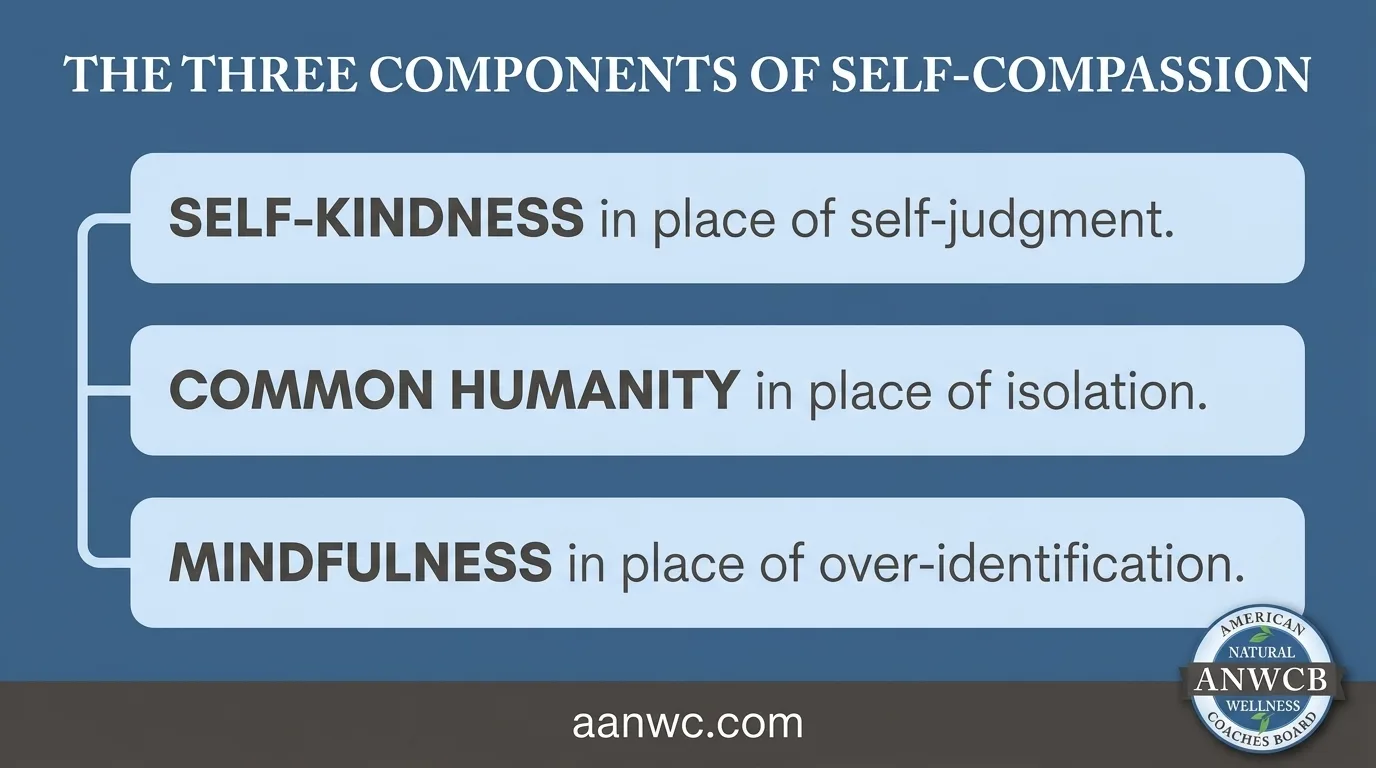
The framework that has given this construct its research footing comes from Kristin Neff, whose work over the past two decades has defined self-compassion as a measurable psychological variable rather than a vague disposition. Neff describes self-compassion as having three components that operate together: self-kindness, common humanity, and mindfulness. Each one corresponds to a specific failure mode that derails behavior change, and each gives a coach a concrete place to intervene. Understanding the three as distinct mechanisms, rather than as a single warm feeling, is what makes the construct usable in a coaching session.

The Three Components, and What Each One Counters
The first component is self-kindness, which Neff frames in direct contrast to self-judgment. When a client slips, the self-critical response treats the lapse as evidence of a flawed character. The self-kind response treats it as an event that happened, one that warrants understanding rather than condemnation. This is not indulgence, and the distinction matters enormously for how a coach presents it. Self-kindness does not mean telling a client the missed workouts were fine or that the plan does not matter. It means helping the client respond to the lapse the way they would respond to a friend in the same position. Most people would never tell a struggling friend that they have no discipline and should give up. They would ask what happened, acknowledge that the week was hard, and help the friend figure out the next step. Self-kindness is the practice of extending that same reasonable, problem-solving warmth inward. The behavioral payoff is specific: a client who is not busy defending themselves against their own contempt has more attention available for the actual question of what to adjust.
The second component is common humanity, which Neff contrasts with isolation. When something goes wrong, the mind tends to personalize it.
I failed because there is something uniquely wrong with me. Everyone else seems to manage this. Common humanity is the recognition that struggle, lapse, and imperfection are part of the shared human experience rather than personal defects. This sounds abstract until you watch it work in a session. A client who believes their struggle is unique carries an extra weight: their slipping means something shameful about them specifically. A client who understands that nearly everyone who attempts sustained change encounters the same setbacks can hold the lapse as information rather than as a verdict. The coach’s role here is often simply to normalize without excusing, to say in effect that this is what change looks like for almost everyone, and that the presence of a setback is not a sign the client is doing it wrong. That reframe alone can keep someone in the process who would otherwise quietly disappear.
The third component is mindfulness, which Neff sets against over-identification. Mindfulness in this specific sense means holding painful thoughts and feelings in balanced awareness rather than being swept away by them. A client over-identified with a lapse is fused with the story: I am a failure, this is hopeless, I always do this. Mindfulness is the small but meaningful step back that lets the client observe the thought as a thought rather than living inside it as a fact. This is the component that most directly enables the other two, because a client who is drowning in the narrative cannot access either kindness or perspective. The coaching move is to help the client name what is happening without amplifying it. Noticing aloud that a harsh story has shown up, and treating it as a passing mental event rather than a truth to be obeyed, creates just enough space for a different response to form.
Reading Which Component Is Missing
What makes Neff’s model useful rather than merely pleasant is that the three components are interdependent, and a coach can diagnose which one is missing. A client who is mindful and connected to common humanity but still brutal toward themselves needs work on self-kindness. A client who is kind to themselves but convinced they are uniquely broken needs the perspective of common humanity. A client who cannot get to either because they are completely fused with the failure story needs mindfulness first. Reading which component is absent in a given moment turns a vague instinct to be supportive into a targeted intervention.
What the Research Actually Shows
The research base behind this is more substantial than the topic’s reputation suggests. Self-compassion has been studied in relation to a wide range of behavior change outcomes, and the pattern is consistent. Higher self-compassion is associated with greater personal initiative and a stronger tendency to take responsibility for mistakes, which directly contradicts the worry that self-compassion produces complacency. People higher in self-compassion are more likely to acknowledge a failure, learn from it, and try again, precisely because the acknowledgment does not trigger an unbearable wave of self-attack. In studies of health behaviors, self-compassion has been linked to better follow-through on intentions, more adaptive responses to dietary lapses, and greater willingness to seek help. The mechanism researchers point to is motivational: self-criticism activates the threat response, which narrows attention and drives avoidance, while self-compassion engages a calmer state from which problem-solving is actually possible. A client in self-attack is in a physiological posture of defense, and defense is not a state from which people make thoughtful adjustments to a routine.
This is where the construct earns its place alongside the more familiar behavior change tools. A client with a perfectly designed implementation intention will still abandon it if the first missed instance triggers a spiral of self-condemnation.

A client with the cleanest habit-stack in the world will still quit if a disrupted week reads to them as proof of personal failure. Self-compassion is not a replacement for a plan. It is the thing that lets a plan survive contact with real life, where weeks fall apart, travel disrupts routines, and motivation comes and goes. The coach who builds only the plan has built something brittle. The coach who also builds the client’s capacity to respond to lapses with kindness, perspective, and balanced awareness has built something that can bend without breaking.
There is a practical objection worth addressing directly, because clients raise it and coaches should be ready for it. Many people genuinely believe that their self-criticism is what got them this far, and they are reluctant to give up the whip. The honest response is not to dismiss this but to distinguish between motivation and the source of motivation. People do accomplish things while criticizing themselves harshly, but research suggests they accomplish them despite the criticism rather than because of it, and at a cost in anxiety, burnout, and eventual avoidance. The coaching conversation is not about lowering standards. A client can hold a high standard and a kind internal response at the same time. In fact, that combination, high standards paired with self-compassion when standards are not met, is precisely the profile associated with the most durable change. The goal is not a client who expects less of themselves. It is a client who recovers faster when they fall short, and therefore falls short less often over time.

What This Looks Like in a Session
In a session, this work rarely announces itself as a self-compassion exercise. It shows up in how a coach responds to the report of a hard week, in the questions asked after a lapse, in whether the conversation about a setback moves quickly toward shame or stays in the steadier territory of understanding and adjustment. A coach who notices a client sliding into self-judgment can gently name it. A coach who hears isolation can offer the perspective of common humanity. A coach who watches a client fuse with a failure story can help them step back into balanced awareness. None of this requires a clinical license or a therapeutic frame. It is squarely within the coaching role: supporting the client’s own capacity to stay engaged with the change they came to make.
It helps to see the three components working together in a single case. Consider a client three months into building a morning movement practice who comes to a session having missed most of the previous two weeks after a family illness pulled her attention elsewhere. The self-critical version of this client opens the session by apologizing, calling herself lazy, and announcing that she clearly cannot stick to anything. A coach working with Neff’s model has three distinct openings.
The mindfulness move comes first: naming, without drama, that a harsh story has arrived and that the missed weeks and the conclusion she has drawn from them are two different things. The common humanity move follows: pointing out that nearly everyone who builds a new practice loses it temporarily when life intervenes, and that a two-week interruption during a family crisis is not a character flaw but an ordinary feature of sustained change. The self-kindness move completes it: inviting her to consider what she would tell a colleague in the same position, and noticing that she would almost certainly not call that colleague lazy. None of these moves involves lowering the goal or pretending the missed weeks did not happen. They change the internal conditions so that the practical question, how to restart the practice this week, becomes answerable instead of buried under self-attack.
The same case shows why sequence matters. A coach who jumps straight to self-kindness with a client still fused with the failure story will often get polite resistance, because the client cannot accept warmth toward a self they currently regard with contempt. Mindfulness is frequently the necessary first step, the small act of separating the person from the story, because it creates the distance the other two components need to land. This is why Neff describes the components as a system rather than a menu. Knowing that over-identification usually has to loosen before kindness or perspective can take hold gives the work a logic rather than leaving it to intuition alone.
There is also a longer arc worth naming for clients who stay with the work. Self-compassion researched as a trait, not just a momentary response, appears to be trainable. Studies of guided self-compassion practice show measurable increases in the trait over time, alongside reductions in the anxiety and rumination that drive avoidance. For a coaching relationship, this means self-compassion is not a fixed feature of a client that a coach must work around. It is a capacity that can grow across an engagement, so that the client who once abandoned a month of progress after one bad day gradually becomes the client who notices the bad day, responds to it with something other than contempt, and is back to the practice by the next morning.

That shift, from brittleness to resilience in the face of inevitable lapses, is often the quiet difference between a client who finishes a program and one who does not.
This kind of attention to the internal conditions that make behavior change possible, the recognition that how a client treats themselves after a lapse matters as much as the plan they lapsed from, is the work of a serious health coach. ANWCB board certifies coaches who ground their practice in what the behavior change research actually shows, including the evidence that self-compassion outperforms self-criticism as a foundation for lasting change.