Health Coach Board Certification: What It Means and How It Supports Professional Clarity

Health coaching is one of the fastest-growing areas within the wellness space, yet it is also one of the least clearly defined. Many people enter health coaching through diverse routes. Some come from fitness, nutrition, education, or personal transformation. Others arrive after formal coursework or certification programs.
This diversity is valuable, but it can also create uncertainty. Health coaches often ask themselves how to describe their role professionally, how to distinguish coaching from other wellness services, and how to communicate credibility without overstating authority. Board certification exists to address that exact tension. Health Coach Board Certification is designed to bring clarity to professional identity in a field that is otherwise difficult to define consistently.
What Health Coach Board Certification Is
Health Coach Board Certification is a professional credential that validates a coach’s education and role alignment within the health coaching field.
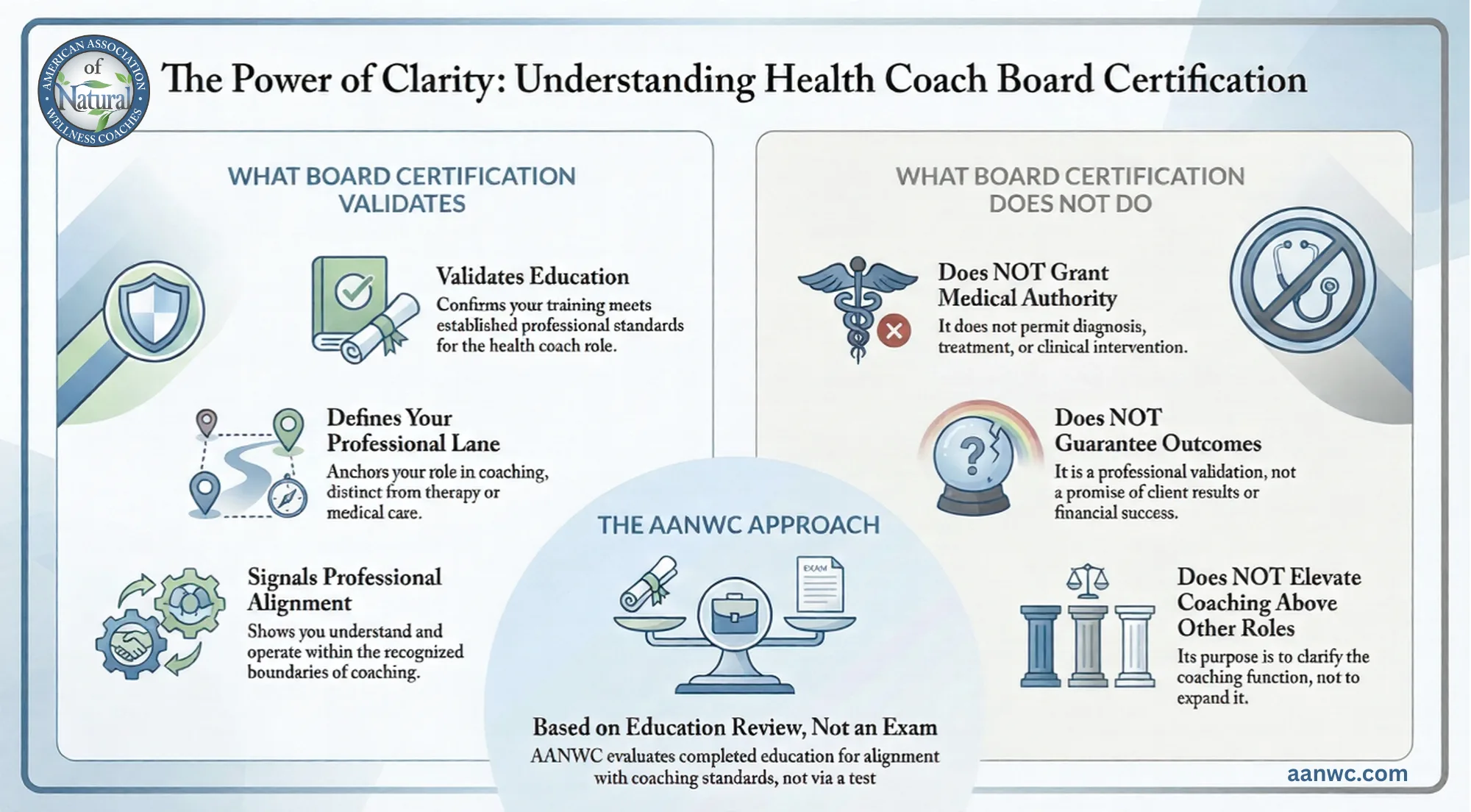
American Association of Natural Wellness Coaches (AANWC) board certification is awarded through an education review process rather than a formal examination. The review evaluates whether a coach’s completed education aligns with established standards for health coaching practice. This credential confirms that a coach’s education has been reviewed by a recognized certifying body and accepted as meeting professional criteria for the health coach role.
What Health Coach Board Certification Validates

Health Coach Board Certification validates several core elements of professional practice.
- It validates education. The certification confirms that a coach has completed training relevant to health coaching and that this education meets defined board standards.
- It validates role clarity. Health coaching is distinct from practitioner work, therapy, and medical care. Board certification reinforces that distinction by clearly anchoring the coach within a coaching lane focused on behavior change, support, and client-centered guidance.
- It validates professional alignment. Board certification signals that a coach understands the boundaries of their role and operates within recognized professional expectations.
These validations help coaches articulate their identity with greater confidence and consistency.
Understanding what board certification does not provide is just as important. Health Coach Board Certification does not grant medical authority. It does not permit diagnosis, treatment, or clinical intervention. It does not replace state licensure or medical credentials.
It does not guarantee client outcomes, financial success, or universal recognition. Board certification is a professional validation, not a promise of results. It also does not elevate coaching above other wellness roles. Coaching serves a specific function, and board certification exists to clarify that function, not to expand it beyond appropriate boundaries.
Why Professional Clarity Matters for Health Coaches
Health coaches often work in environments where role confusion is common. Clients may not understand what coaching involves or how it differs from other wellness services. Coaches themselves may struggle to explain their scope clearly. Professional clarity reduces these challenges.
Board certification gives coaches a structured way to explain who they are, what they do, and how their role fits within the broader wellness landscape. This clarity supports better communication, stronger professional confidence, and healthier client relationships.
Health Coaching as a Defined Professional Lane
One of the most important contributions of board certification is that it defines health coaching as its own professional lane. Health coaches focus on supporting clients through behavior change, accountability, education, and goal alignment. They do not diagnose conditions or prescribe interventions. They work alongside, not in place of, licensed or clinical professionals.
Health Coach Board Certification reinforces this lane by validating education that is specifically designed for coaching, not for practitioner or medical roles.
Education Review Rather Than Examination
Health Coach Board Certification through AANWC is review-based. Instead of testing through an exam, the board evaluates completed education for relevance, scope, and alignment with coaching standards.
This approach acknowledges the wide variety of legitimate health coaching training programs while still maintaining professional benchmarks. It allows coaches from different educational backgrounds to be evaluated fairly and consistently. For many coaches, this review-based model feels more aligned with the relational and educational nature of coaching itself.
When Coaches Typically Pursue Board Certification

There is no single timeline for pursuing board certification. Some coaches seek board certification early to establish professional clarity as they begin working with clients. Others pursue it after gaining experience, as a way to formalize their role and education. Board certification is not tied to a specific career stage. It is a professional tool that can be useful whenever a coach feels ready to define their identity more clearly.
Trust in health coaching is built through transparency, boundaries, and consistency. Board certification supports trust by signaling that a coach’s education has been reviewed and that their role is clearly defined.
It does not replace personal rapport or ethical practice, but it adds an additional layer of professional accountability. Clients benefit from knowing that their coach operates within recognized standards rather than personal interpretation alone.
In a field that continues to evolve rapidly, board certification provides a stabilizing framework. It helps coaches avoid role drift, overextension, or unintentional misrepresentation. It also supports long-term professional development by anchoring identity in clearly articulated standards rather than trends or informal titles. For many coaches, this stability is just as valuable as the credential itself.
Using Board Certification Responsibly
Like any professional credential, board certification should be communicated accurately and responsibly. Its value lies in clarity, not in authority. Coaches who understand this use the credential to support transparency and trust rather than to imply outcomes or expertise beyond their scope. When framed correctly, Health Coach Board Certification becomes a tool for alignment rather than promotion.
For health coaches who want to better understand how board certification works and what standards are involved, reviewing certification criteria can provide helpful context. Learning how education is evaluated allows coaches to decide whether board certification aligns with their professional goals and background.